
The new frontier of exploration.
Mars Daily Editorial Team
Editorial Team

Mars Daily Editorial Team

Editorial Team

The Mars Daily Editorial Team produces Mars Daily's coverage of Mars exploration and science. We report on rovers and orbiters, sample-return and human-Mars planning, and the geology, atmosphere and astrobiology of the Red Planet. Articles reflect our team's collective editorial process, source verification, drafting, technical review, and editing, rather than a single writer's work. Mars Daily takes editorial responsibility for content under this byline. For more on how we work, see our editorial policy.

Legacy Reports

Mars’ Molten Past

Houston TX (SPX) Nov 22, 2007 - Mars was covered in an ocean of molten rock for about 100 million years after the planet formed, researchers from the Lunar and Planetary Institute in Houston, Texas, UC Davis, and NASA's Johnson Space Center have found. The work is published in the journal Nature on Nov. 22. The formation of the solar system can be dated quite accurately to 4,567,000,000 years ago, said Qing-Zhu Yin, assistant professor of geology at UC Davis and an author on the paper.


Legacy Reports

Questioning Martian Life

Paris, France (SPX) Nov 22, 2007 - The European Mars Science and Exploration Conference: Mars Express and ExoMars concluded on November 16 at ESA's Technology Centre (ESTEC) in Noordwijk, The Netherlands. The conference covered a range of topics concerning Mars exploration, including results from the Mars Express satellite after almost four years in orbit and preparations for Europe's upcoming ExoMars mission. Here we present interviews with selected experts on some hot topics concerning Mars.

Legacy Reports

Rover Finds Way To Brush Rock Surfaces Despite Setbacks

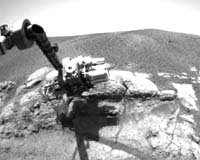
Pasadena CA (JPL) Nov 15, 2007 - Opportunity is still parked in front of the rock layer known as Smith inside Victoria Crater. The rover has now lost two encoders that operate motors on the rock abrasion tool during the grinding and brushing of surfaces. Science team members and engineers have been working in test beds and computer sequencing rooms to devise creative ways of using the rock abrasion tool without the grind and revolve encoders.

Legacy Reports

Spirit Continues Drive As Power Levels Decline

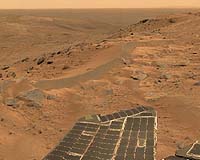
Pasadena CA (SPX) Nov 14, 2007 - Spirit has been gradually losing power, with energy levels dropping to 320 watt-hours per Martian day (100 watt-hours is the amount of energy needed to light a 100-watt bulb for one hour). Measurements of atmospheric dust, known as Tau, have been averaging 0.65. That dust level is typical of levels measuring throughout most of the mission, but power levels are lower than in previous years because of higher dust accumulation on the solar panels.

Legacy Reports

Opportunity’s Second Martian Birthday At Cape Verde

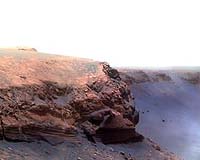
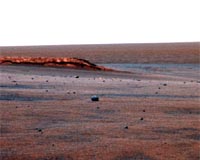
Pasadena CA (SPX) Nov 08, 2007 - A promontory nicknamed Cape Verde can be seen jutting out from the walls of Victoria Crater in this approximate true-color picture taken by the panoramic camera on NASA's Mars Exploration Rover Opportunity. The rover took this picture on martian day, or sol, 1329 (Oct. 20, 2007), more than a month after it began descending down the crater walls - and just 9 sols shy of its second Martian birthday on sol 1338 (Oct. 29, 2007).

Legacy Reports

Spirit Continues Studies Of Rocks On Home Plate

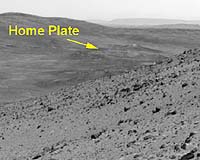
Pasadena CA (SPX) Oct 31, 2007 - Spirit is healthy and continues to investigate Home Plate. After completing extensive studies of Site 3 using the Moessbauer spectrometer and other instruments, the rover proceeded toward Site 4. Meanwhile, it's already time for Spirit to start thinking about winter again. Over the coming weekend, the rover was scheduled to acquire long-baseline stereo images of Home Plate and surrounding areas in search of a safe winter haven.

Legacy Reports

Mars Ice Shaken Not Stirred

Boulder, CO (SPX) Oct 28, 2007 - Mars, like Earth, is a climate-fickle water planet. The main difference, of course, is that water on the frigid Red Planet is rarely liquid, preferring to spend almost all of its time traveling the world as a gas or churning up the surface as ice. That's the global picture literally and figuratively coming into much sharper focus as various Mars-orbiting cameras send back tomes of unprecedented super high-resolution imagery of ever vaster tracts of the planet's surface.

Legacy Reports

UA’s Phoenix Mars Mission Gets A Chance To Lounge

Tuscon AZ (SPX) Oct 22, 2007 - The University of Arizona will open the new UA Mars Lounge, dedicated to its Phoenix Mars Mission, and unveil a large landing clock on Sunday at 1 p.m. in the Student Union Memorial Center. The mission's principal investigator, Peter Smith, will unveil the clock in the Student Union rotunda. The lounge was designed to give students, faculty, staff and visitors a glimpse into what UA scientists have contributed to this first mission of NASA's Scout Mission Program through a collection of images and multimedia presentations.