The new frontier of exploration.
Mars Daily Editorial Team
Editorial Team

Mars Daily Editorial Team

Editorial Team

The Mars Daily Editorial Team produces Mars Daily's coverage of Mars exploration and science. We report on rovers and orbiters, sample-return and human-Mars planning, and the geology, atmosphere and astrobiology of the Red Planet. Articles reflect our team's collective editorial process, source verification, drafting, technical review, and editing, rather than a single writer's work. Mars Daily takes editorial responsibility for content under this byline. For more on how we work, see our editorial policy.

Legacy Reports

Spirit Arrives At Stratigraphic Wonderland In Columbia Hills On Mars

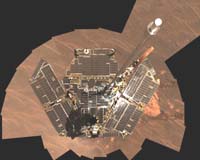
Pasadena CA (JPL) Sep 28, 2007 - Spirit completed the rover's longest 5-wheel drive to date en route to a platy rock surface nicknamed Texas Chili in an area scientists are calling a stratigraphic wonderland. The platy outcrop is at site 3 on top of Home Plate and is the focus of in-depth scientific investigation. Two sols after not receiving a scheduled data transmission, Spirit drove 19.21 meters (63.02 feet) to the rover's current location about 15 meters (49 feet) away from a field of boulders.

Legacy Reports

Tracing Martian Water

Moffett Field CA (SPX) Sep 26, 2007 - NASA's Mars Reconnaissance Orbiter (MRO) is examining several features on Mars that address the role of water at different times in Martian history. Liquid water is essential for life as we know it, and determining the history of water on Mars is vital in understanding whether or not the planet could have supported life in its past. Studying locations where water may have flowed and pooled on the martian surface will also help researchers choose the most interesting and scientifically important landing sites for future Mars missions.

Legacy Reports

NASA Orbiter Finds Possible Cave Skylights On Mars

Pasadena CA (SPX) Sep 24, 2007 - NASA's Mars Odyssey spacecraft has discovered entrances to seven possible caves on the slopes of a Martian volcano. The find is fueling interest in potential underground habitats and sparking searches for caverns elsewhere on the Red Planet. Very dark, nearly circular features ranging in diameter from about 100 to 250 meters (328 to 820 feet) puzzled researchers who found them in images taken by NASA's Mars Odyssey and Mars Global Surveyor orbiters. Using Mars Odyssey's infrared camera to check the daytime and nighttime temperatures of the circles, scientists concluded that they could be windows into underground spaces.

Legacy Reports

Shaking Off The Dust And Getting Back To Work

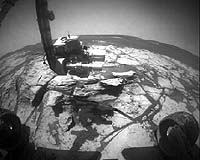
Pasadena CA (JPL) Sep 21, 2007 - The skies continue to clear over the Opportunity site, and the dust is falling from both the sky and the rover. The last week was dedicated to evaluating the payload and assessing dust accumulation on the instruments. Fortunately, the solar array energy has improved to over 350 Watt-hours for the last four sols. This has given the vehicle enough power to support two alpha particle X-ray spectrometer integrations and two Mars Express UHF overflights.

Legacy Reports

Changes to Mars Science Lab Project Respond to Cost Increases And Keep Program On Track

Pasadean CA (JPL) Sep 19, 2007 - In early June 2007, the Mars Science Laboratory project completed its project-wide Critical Design Review (CDR), which marks the completion of the project's design phase and transition into the build up of flight hardware. A key component of the CDR process was a technical risk, programmatic, and cost review, from which multiple independent cost assessments predicted that this technically challenging $1.7B planetary science rover mission's current content would cause it to exceed its budgeted development costs to launch by approximately $75M.

Legacy Reports

Odyssey Returning to Service After Taking Precaution

Pasadena CA (SPX) Sep 19, 2007 - The team operating NASA's Mars Odyssey orbiter is returning the healthy spacecraft to usual activities this week after a precautionary status of reduced activity that the orbiter entered on Sept. 14. Odyssey properly put itself into the standby safe mode in response to a root cause that engineers have diagnosed as the same cause as for two previous safe mode entries, in 2005 and 2006.

Legacy Reports

The UA Is Over The Moon About Mars

Tuscon AZ (SPX) Sep 18, 2007 - The Phoenix Mars Mission is on its way to the Red Planet after a flawless launch from Cape Canaveral in early August. With landing scheduled for late May 2008, it might seem like there is nothing to do but wait through a long nine months. But The University of Arizona won't be idle during the cruise phase. Mission scientists are diligently preparing for landing and science operations. And the rest of the UA is quite busy, too, with celebration activities planned for every month through landing.

Legacy Reports

New Theory Explains Ice On Mars

Honolulu HI (SPX) Sep 14, 2007 - Wobbles on Mars cause ice ages that are much more dramatic than those on Earth, says astronomer Norbert Schorghofer of the University of Hawaii. Thanks to our large, stabilizing Moon, Earth's rotation axis is always tilted by about 23 degrees. The tilt of Mars, however, can wobble by as much as 10 degrees from its current 25 degrees. Wobbles cause big changes in the amount of sunlight reaching different parts of Mars, so vast amounts of ice shift between the poles and the rest of the planet every 120,000 years.

Legacy Reports

The Mysterious Ridges At The Mouth Of Tiu Valles

Paris, France (ESA) Sep 13, 2007 - These images taken by the High Resolution Stereo Camera (HRSC) on board Mars Express show the mouth of the Tiu Valles channel system on the red planet. The pictures were taken in orbit 3103 on 10 June 2006 with a ground resolution of approximately 16 metres per pixel. The mouth of Tiu Valles is an estuary-like landform. On Earth, an estuary is the tidal mouth of a river valley, or the end that meets the sea and fresh water comes into contact with seawater. In such an area, tidal effects are evident.

Legacy Reports

Opportunity Takes A Dip Into Victoria Crater

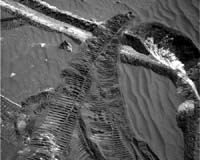
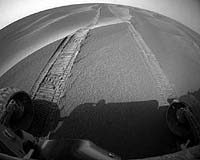
Pasadena CA (SPX) Sep 13, 2007 - NASA's Mars Exploration Rover Opportunity has entered Victoria Crater for the first time. It radioed home information via a relay by NASA's Mars Odyssey orbiter, reporting its activities for the day. Opportunity drove far enough in -- about four meters (13 feet) -- to get all six wheels past the crater rim. Then it backed uphill for about three meters (10 feet). The driving commands for the day included a precaution for the rover to stop driving if its wheels were slipping more than 40 percent.