The new frontier of exploration.
Mars Daily Editorial Team
Editorial Team

Mars Daily Editorial Team

Editorial Team

The Mars Daily Editorial Team produces Mars Daily's coverage of Mars exploration and science. We report on rovers and orbiters, sample-return and human-Mars planning, and the geology, atmosphere and astrobiology of the Red Planet. Articles reflect our team's collective editorial process, source verification, drafting, technical review, and editing, rather than a single writer's work. Mars Daily takes editorial responsibility for content under this byline. For more on how we work, see our editorial policy.

Legacy Reports

Phoenix Adjusts Course Successfully For Journey To Mars

Pasadena (SPX) Aug 12, 2007 - NASA has commanded the Phoenix Mars Lander to make the first and largest of six course corrections planned during the spacecraft's flight from Earth to Mars. Phoenix left Earth Aug. 4, bound for a challenging touchdown on May 25, 2008, at a site farther north than any previous Mars landing. It will robotically dig to underground ice and run laboratory tests assessing whether the site could ever have been hospitable to microbial life.

Legacy Reports

Helping Phoenix Land

Tucson AZ (SPX) Aug 10, 2007 - The Phoenix Mars Lander launched on Saturday, August 4, beginning a journey to never-explored regions of the Red Planet to search for frozen water beneath the Martian surface. What it discovers will help scientists determine if Mars could support life. NASA's Jet Propulsion Laboratory (JPL) in Pasadena, Calif. and Langley Research Center in Hampton, Va. are working together with the University of Arizona and Lockheed Martin Space Systems on Phoenix, the first project in NASA's Mars Scout Missions program.

Legacy Reports

Brighter Skies Lifts Rover Spirit As MER-A Gets Active

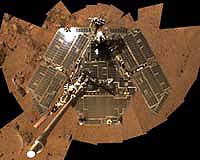
Pasadena CA (JPL) Aug 09, 2007 - Slight clearing of still-dusty Martian skies has improved the energy situation for both Spirit and Opportunity, allowing controllers to increase the rovers' science observations. Spirit is even being commanded to move its arm for the first time in nearly three weeks. It will position the arm's microscopic imager to take a series of photographs of two soil targets and one rock target. Opportunity's planned science observations are for studies of the atmosphere.

Legacy Reports

Dallas Professor Helps Mission To Red Planet

Dallas TX (SPX) Aug 08, 2007 - Dr. John H. Hoffman, a space scientist at The University of Texas at Dallas, was on hand Saturday as the Delta II rocket carrying the Phoenix Mars lander lifted off from Cape Canaveral Air Force Base for a 10-month long journey to the Red Planet. A physics professor and member of the University's William B. Hanson Center for Space Sciences, Hoffman is part of team of researchers lead by Dr. Peter Smith of the University of Arizona in Tucson who were selected in 2003 by the National Aeronautics and Space Administration (NASA) to lead an unmanned mission to Mars. The team, among other tasks, was asked to look for evidence of past habitability on Mars.

Legacy Reports

Extreme Analytical Chemistry Will Help Unravel Mars Mysteries

Somerville MA (SPX) Aug 05, 2007 - Sam Kounaves spends his time unraveling fundamental questions in planetary science by applying extreme analytical chemistry to the harshest environments imaginable: Places like Death Valley, Antarctica - and now Mars. The Tufts professor is a co-investigator on NASA's Phoenix Mars Lander Mission currently scheduled for launch on August 4. Kounaves will be leading the chemical analysis of Martian soil and ice after the Lander craft touches down on Mars in May 2008.

Legacy Reports

NASA Sends Robotic Lander In Search Of Water And Life On Mars

Washington (AFP) Aug 04, 2007 - A US space probe embarked Saturday on a 10 month journey to Mars, where it will dig through Martian soil in a search for signs of life in a frigid region of the Red Planet. The Phoenix Mars Lander separated from a Delta II rocket after blasting off into the dark sky at 5:36 am (0936 GMT) from the Kennedy Space Center in Cape Canaveral, Florida. Powered by solar panels, Phoenix, whose launch was delayed by one day following bad weather, is scheduled to land on Mars on May 25, 2008, after traveling 680 million kilometers (422 million miles) through space.

Legacy Reports

Growing Concern That Opportunity Is Freezing To Silence

Pasadena CA (JPL) Aug 02, 2007 - Rover engineers are growing increasingly concerned about the temperature of vital electronics on NASA's Mars Exploration Rover Opportunity while the rover stays nearly inactive due to a series of dust storms that has lasted for more than a month. Dust in the atmosphere and dust settling onto Opportunity's solar panels challenges the ability of the solar panels to convert sunlight into enough electricity to supply the rover's needs.

Legacy Reports

Interplanetary Networking As Mars Express Prepares To Keep An Eye On Phoenix

Paris, France (ESA) Aug 02, 2007 - ESA's Mars Express will keep an eye on NASA's Phoenix lander as it makes its way to the Martian surface, setting an example for international cooperation and interplanetary networking. Phoenix's launch is scheduled for 4 August this year and it is expected to land on the Red Planet in the spring of 2008. The mission will investigate the Martian environment and will look beneath the frigid, arctic landscape in search of conditions favourable to past or present life.

Legacy Reports

Next Departure For Mars Stands Ready To Fly

Cape Canaveral FL (SPX) Aug 02, 2007 - A NASA robotic explorer equipped to dig up and analyze icy soil on Mars sits atop a 13-story tall stack of rocket engines prepared for liftoff before sunup on Saturday. A Delta II launch vehicle will carry the Phoenix Mars Lander into Earth orbit and, about 90 minutes later, give it the push needed to send it to Mars. A three-week period when planetary positions are favorable for this launch begins with an opportunity at 2:26:34 a.m. PDT (5:26:34 a.m. EDT) on Aug. 4. A second opportunity the same day, if needed, will come at 3:02:59 a.m. PDT (6:02:59 a.m. EDT).

Legacy Reports

Phoenix Will Dig For Water And Life On Edge Of Northern Polar Zone Of Mars

Washington (AFP) Aug 02, 2007 - NASA on Saturday is to launch space probe Phoenix on a nine-month journey to Mars' arctic region, where it will dig through ice for clues to past or present microbial life on the red planet. The Phoenix Mars Lander is scheduled for blastoff from Cape Canaveral, Florida on August 4, with a first attempt at 5:36 am (0936 GMT), and a second attempt, should it be needed, at 6:02 am (1002 GMT). It was originally scheduled to launch on Friday, but postponed 24 hours after adverse weather Tuesday prevented fueling of the two-stage Delta II rocket that will propel Phoenix into space.

Legacy Reports

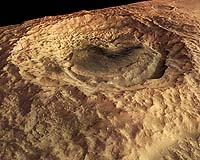
Impact Craters In Tyrrhena Terra

Paris, France (ESA) Aug 01, 2007 - The High Resolution Stereo Camera (HRSC) on board ESA's Mars Express obtained images of the Tyrrhena Terra region on Mars. On 10 May 2007, the pictures of the region located at 18 South and 99 East were taken during orbit number 4294 with a ground resolution of approximately 15 metres per pixel. Tyrrhena Terra is part of the ancient, heavily cratered southern Martian highlands. The region is located north of Hellas Planitia, the largest impact basin on Mars.

Legacy Reports

US-Canadian Team On 4-Month Simulated Mars Mission

Washington DC (SPX) Aug 01, 2007 - When the Phoenix Mars Lander reaches the Red Planet in 2008, the $386-million robotic mission will begin exploring the icy Martian soil. Meanwhile, in a remote field station here on Earth, Canadian and American scientists have been engaged in a simulated expedition to Mars. There is no place on Earth like Mars, except perhaps the arctic polar desert where Canadian geologist Melissa Battler commands a simulated mission at the Flashline Mars Arctic Research Station, 1400 kilometers from the North Pole on Devon Island.

Legacy Reports

Fossil Hunting On Mars

Moffett Field CA (ARC) Jul 31, 2007 - To date, only NASA has succeeded in sending a rover to explore our neighboring planet Mars. That is about to change. In 2011, the European Space Agency will send ExoMars to the Red Planet in search of signs that Mars is, or was, a living world. Astrobiology Field Research Editor Henry Bortman recently interviewed the ExoMars project scientist, Jorge Vago. In this, the second part of a two-part interview, Vago explains why ExoMars will focus on looking for fossil evidence of ancient life and why such evidence may be easier to find on Mars than it is on Earth.

Legacy Reports

Weather Delays Phoenix Mars Probe Launch

Washington (AFP) July 31, 2007 - Adverse weather Tuesday at Cape Canaveral, Florida, delayed by 24 hours the launch of Mars probe Phoenix on its novel mission to dig in Martian soil for water and signs of life, NASA said. Weather conditions prevented fueling of the two-stage Delta II rocket atop which Phoenix was scheduled to blast off on Friday, the US space agency said in a statement. The two available launch times on Saturday, Aug. 4, are 2:26:34 and 3:02:59 a.m. Pacific Time (5:26:34 a.m. and 6:02:59 a.m. Eastern Time). Due to a forecast for severe weather around the Kennedy Space Center launch pad on Tuesday afternoon, fueling of the second stage will not be completed Tuesday afternoon.

Legacy Reports

Planetary Society Set To Launch First Library Of Mars

Pasadena CA (SPX) Jul 31, 2007 - The Planetary Society's silica-glass DVD is ready to launch to Mars on board Phoenix, NASA's newest Scout mission led by Principal Investigator Peter Smith at the University of Arizona. Attached to the deck of the Phoenix lander, the DVD includes Visions of Mars, a collection of 19th and 20th century stories, essays and art inspired by the Red Planet, as well as the names of over a quarter million inhabitants of Earth. The disk will appear in some of the calibration images that Phoenix sends back from the Martian surface.