The new frontier of exploration.
Mars Daily Editorial Team
Editorial Team

Mars Daily Editorial Team

Editorial Team

The Mars Daily Editorial Team produces Mars Daily's coverage of Mars exploration and science. We report on rovers and orbiters, sample-return and human-Mars planning, and the geology, atmosphere and astrobiology of the Red Planet. Articles reflect our team's collective editorial process, source verification, drafting, technical review, and editing, rather than a single writer's work. Mars Daily takes editorial responsibility for content under this byline. For more on how we work, see our editorial policy.

Legacy Reports

Noctis Labyrinthus, Labyrinth Of The Night

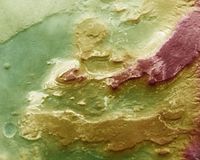
Paris, France (ESA) Dec 03, 2007 - These images taken by the High-Resolution Stereo Camera (HRSC), onboard ESA's Mars Express imaged the Noctis Labyrinthus region, the 'labyrinth of the night' on Mars. The HRSC took these pictures on 25 June 2006 in orbit 3155, with a ground resolution of approximately 16 m/pixel. Noctis Labyrinthus lies at approximately 6.5 south and 260 east. The Sun illuminates the scene from the north-west, top right in the image above.

Legacy Reports

Russia Conducts First Experiment In Preparation For Mars-500

Moscow (RIA Novosti) Nov 30, 2007 - Russian scientists have completed the first stage of preparations for an experimental Mars mission simulation, Mars-500, a medical research institute announced on Thursday. The purpose of the main experiment, expected to begin in late 2008, is to simulate a space flight to Mars taking into account all ramifications, including a 250-day trip to the Red Planet, a 30-day period on its surface, and a 240-day return flight.

Legacy Reports

Rover Perseveres Despite Stall In Robotic Arm

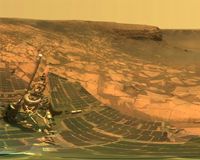
Pasadena CA (JPL) Nov 30, 2007 - Opportunity spent much of the week conducting ongoing studies of a layer of rock known as Smith, part of a bathtub ring of rocks that circumvent Victoria Crater beneath the rim. Opportunity acquired images and studied the composition and abundance of iron-bearing minerals in the rock. During tests of the rock abrasion tool on the Earthbound engineering rover similar to the rover on Mars, engineers discovered that unbending the brush on Opportunity's rock abrasion tool may not be possible.

Legacy Reports

Rover Slips In Sandy Terrain

Pasadena CA (SPX) Nov 29, 2007 - On the way to Winter Haven 3, the spot on the north face of Home Plate where NASA's Spirit rover is headed, the rover has driven into an area below a hummock (elevated area). Spirit has tried unsuccessfully during the past week to climb onto the hummock and make progress toward Winter Haven 3. Because it is critical to reach the north face while enough solar energy is available to get there, Spirit spends every available day driving. In-between drives, Spirit recharges the batteries and conducts very light remote sensing.

Legacy Reports

HiRISE Camera Views Spirit At Home Plate

Pasadena CA (SPX) Nov 28, 2007 - The High Resolution Imaging Science Experiment, or HiRISE, camera onboard NASA's Mars Reconnaissance Orbiter has taken a new color image of the feature dubbed Home Plate in Gusev Crater on Mars. The Mars Exploration Rover Spirit shows up inside the perimeter of Home Plate, where it was when HiRISE took the image on Sept. 27, 2007, at 2:19 pm local Mars time, HiRISE team member Ken Herkenhoff of the U.S. Geological Survey, Flagstaff, said.

Legacy Reports

New Views Of Martian Moons

Laurel MD (SPX) Nov 28, 2007 - These two images taken by the Compact Reconnaissance Imaging Spectrometer for Mars (CRISM) show Mars' two small moons, Phobos and Deimos, as seen from the Mars Reconnaissance Orbiter's low orbit around Mars. Both images were taken while the spacecraft was over Mars' night side, with the spacecraft turned off its normal nadir-viewing geometry to glimpse the moons. The image of Phobos, shown at the top, was taken at 0119 UTC on October 23 (9:19 p.m. EDT on Oct. 22), and shows features as small as 400 meters (1,320 feet) across.

Legacy Reports

Opportunity Peers Beneath Surface Of Bathtub Ring

Pasadena CA (SPX) Nov 26, 2007 - Opportunity remains parked at the rock layer known as Smith -- part of the bathtub ring of rock layers beneath the edge of Victoria Crater - - at Duck Bay, the alcove where the rover entered the crater. During a test of the wire brush on the rock abrasion tool in a new mode of operation developed to work around recent encoder failures, Opportunity was mistakenly commanded to rotate the brush in the wrong direction.

Legacy Reports

Mars’ Molten Past

Houston TX (SPX) Nov 22, 2007 - Mars was covered in an ocean of molten rock for about 100 million years after the planet formed, researchers from the Lunar and Planetary Institute in Houston, Texas, UC Davis, and NASA's Johnson Space Center have found. The work is published in the journal Nature on Nov. 22. The formation of the solar system can be dated quite accurately to 4,567,000,000 years ago, said Qing-Zhu Yin, assistant professor of geology at UC Davis and an author on the paper.

Legacy Reports

Questioning Martian Life

Paris, France (SPX) Nov 22, 2007 - The European Mars Science and Exploration Conference: Mars Express and ExoMars concluded on November 16 at ESA's Technology Centre (ESTEC) in Noordwijk, The Netherlands. The conference covered a range of topics concerning Mars exploration, including results from the Mars Express satellite after almost four years in orbit and preparations for Europe's upcoming ExoMars mission. Here we present interviews with selected experts on some hot topics concerning Mars.

Legacy Reports

Rover Finds Way To Brush Rock Surfaces Despite Setbacks

Pasadena CA (JPL) Nov 15, 2007 - Opportunity is still parked in front of the rock layer known as Smith inside Victoria Crater. The rover has now lost two encoders that operate motors on the rock abrasion tool during the grinding and brushing of surfaces. Science team members and engineers have been working in test beds and computer sequencing rooms to devise creative ways of using the rock abrasion tool without the grind and revolve encoders.

Legacy Reports

Spirit Continues Drive As Power Levels Decline

Pasadena CA (SPX) Nov 14, 2007 - Spirit has been gradually losing power, with energy levels dropping to 320 watt-hours per Martian day (100 watt-hours is the amount of energy needed to light a 100-watt bulb for one hour). Measurements of atmospheric dust, known as Tau, have been averaging 0.65. That dust level is typical of levels measuring throughout most of the mission, but power levels are lower than in previous years because of higher dust accumulation on the solar panels.