
The new frontier of exploration.
Mars Daily Editorial Team
Editorial Team

Mars Daily Editorial Team

Editorial Team

The Mars Daily Editorial Team produces Mars Daily's coverage of Mars exploration and science. We report on rovers and orbiters, sample-return and human-Mars planning, and the geology, atmosphere and astrobiology of the Red Planet. Articles reflect our team's collective editorial process, source verification, drafting, technical review, and editing, rather than a single writer's work. Mars Daily takes editorial responsibility for content under this byline. For more on how we work, see our editorial policy.

Legacy Reports

NASA Orbiter Reveals New Details Of Mars Both Young And Old

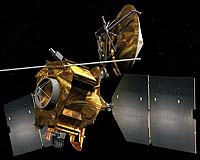
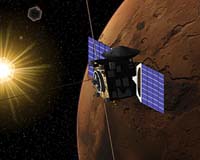
Pasadena CA (SPX) Oct 17, 2006 - During its first week of observations from low orbit, NASA's newest Mars spacecraft is already revealing new clues about both recent and ancient environments on the red planet. Scientists hope the Mars Reconnaissance Orbiter will answer questions about the history and distribution of Mars' water by combining data from the orbiter's high-resolution camera, imaging spectrometer, context camera, ground-penetrating radar, atmospheric sounder, global color camera, radio and accelerometers.
Legacy Reports

Opportunity Set To Clock Up Six Miles On Mars

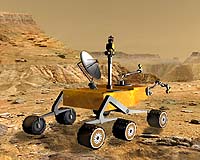
Pasadena CA (JPL) Oct 10, 2006 - NASA's Mars Exploration Rover Opportunity reached the rim of Victoria Crater on Sept. 27, 2006, during the 951st Martian day, or sol, of the rover's work in the Meridian Planum region of Mars. Opportunity drove 9.28 kilometers (5.77 miles) in the explorations that took it from Eagle Crater, where it landed in January 2004, eastward to Endurance Crater, which it investigated for about half of 2004, then southward to Victoria.

Legacy Reports

NASA Spots Opportunity In Stunning MRO Image Of Victoria Crater

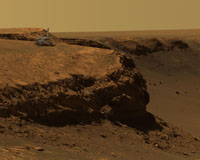
Pasanea CA (JPL) Oct 06, 2006 - NASA's long-lived robotic rover Opportunity is beginning to explore layered rocks in cliffs ringing the massive Victoria crater on Mars. While Opportunity spent its first week at the crater, NASA's newest eye in the Martian sky photographed the rover and its surroundings from above. The level of detail in the photo from the high-resolution camera on the Mars Reconnaissance Orbiter will help guide the rover's exploration of Victoria.

Legacy Reports

APL-Built Mineral-Mapping Imager Begins Mission At Mars

Laurel MD (SPX) Oct 02, 2006 - The most powerful mineral-mapper ever sent to Mars has opened its protective cover and is about to begin its search for hints of past water on the red planet. The Compact Reconnaissance Imaging Spectrometer for Mars (CRISM), designed and built by the Johns Hopkins University Applied Physics Laboratory in Laurel, Md., is one of six science instruments aboard NASA's Mars Reconnaissance Orbiter.

Legacy Reports

Victoria Crater Marks Giant Cake For 1000 Sols On Mars

Pasadena CA (SPX) Oct 02, 2006 - On Mars, over the next few weeks, two robotic explorers will reach 1000 sols a piece. At a real cost that's now under $350,000 a day, the 2004 Mars Rovers have been an engineering and scientific triumph beyond all expectation. And crowning the success of the missions has been the arrival of Opportunity at the rim of Victoria Crater, and the awakening of Spirit from it's long sebatical during the Martian winter.

Legacy Reports

NASA Mars Rover Arrives At Dramatic Vista On Red Planet

Pasadena CA (JPL) Sep 28, 2006 - NASA's Mars Rover Opportunity has arrived at the rim of a crater approximately five times wider than a previous stadium-sized one it studied for half a year. Initial images from the rover's first overlook after a 21-month journey to Victoria Crater show rugged walls with layers of exposed rock and a floor blanketed with dunes. The far wall is approximately one-half mile from the rover.

Legacy Reports

Spirit Activates New Software

Pasadena CA (JPL) Sep 26, 2006 - Following some dramatic scrambling by rover handlers to command both Mars Exploration Rovers to switch to new flight software during a bit of a traffic jam at the Red Planet, Spirit successfully woke up and began operating with the new software. The X-band frequency for communicating directly with Earth had become unavailable while being used by NASA's Mars Reconnaissance Orbiter during critical events for that mission.