
The new frontier of exploration.
Mars Daily Editorial Team
Editorial Team

Mars Daily Editorial Team

Editorial Team

The Mars Daily Editorial Team produces Mars Daily's coverage of Mars exploration and science. We report on rovers and orbiters, sample-return and human-Mars planning, and the geology, atmosphere and astrobiology of the Red Planet. Articles reflect our team's collective editorial process, source verification, drafting, technical review, and editing, rather than a single writer's work. Mars Daily takes editorial responsibility for content under this byline. For more on how we work, see our editorial policy.

Legacy Reports

1000 Sols On Mars

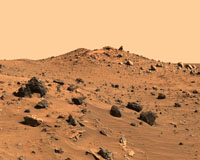
Pasadena (JPL) Oct 26, 2006 - NASA's long-lived Mars Exploration Rover Spirit will finish its 1,000th Martian day Thursday, continuing a successful mission originally planned for 90 Martian days. A color 360-degree panorama released today -- produced from the most detailed imaging yet completed by either Spirit or its twin, Opportunity -- shows rugged terrain of the robot's current location amid a range of hills. Spirit has been examining the surroundings for several months while perched with a tilt to the north for maximum solar energy during winter in Mars' southern hemisphere.

Legacy Reports

Study Fuels Debate Of Life On Mars

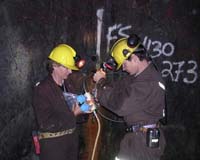
Bloomington IN (Indiana Daily Student) Oct 25, 2006 - A new IU study that found a self-sustaining community of bacteria living 2.8 kilometers below the Earth's surface fuels optimism that similar life could exist on Mars. According to the study, published in this week's issue of the peer-reviewed journal Science, the bacteria community, which lives completely independent of resources found on Earth's surface, supports itself using resources obtained from water molecules that are converted into energy by radioactive uranium found in subsurface rocks.

Legacy Reports

Preparations Continue For Manned Expedition To Mars One Day

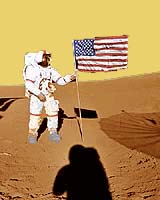
Moscow, Russia (SPX) Oct 25, 2006 - The 1920s are remembered not only for their political upheavals but also for a new interest in exploring other planets. Imaginative authors of all calibers wove intricate fantasies about exploring the length and breadth of Mars in their books. The budding movie industry made its contribution, too. But it is only a century later, in the 2020s, that humankind has hope of finally touching down on the Red Planet.

Legacy Reports

ESA To Take Part In Russian Mars Experiment

Moscow, Russia (RIA) Oct 24, 2006 - The European Space Agency has decided to take part in a Russian simulated flight to Mars, and two Europeans could be among the volunteers, a Russian scientist said Tuesday. The Institute of Medical and Biological Issues in northern Moscow, the venue for the Mars-500 experiment that will last 520 days, has received applications from more than 120 people from 21 countries, including Russia, Ukraine, Belarus, the United States, the United Kingdom, Belgium, Mexico, Argentina, Italy, Spain, Estonia, and Bulgaria.

Legacy Reports

Decoding The Cryptic Region Of Mars

Paris, France (ESA) Oct 20, 2006 - Mars Express's OMEGA instrument has given planetary scientists outstanding new clues to help solve the mystery of Mars's so-called 'cryptic region'. In the 1970s, orbiter missions around Mars revealed that during southern spring, large areas near Mars's south pole became much darker than the rest of the seasonal ice cap. How could this area be in the polar region and not be covered in bright ice? Intrigued, planetary scientists called the area the 'cryptic region' of the south seasonal cap.

Legacy Reports

Full-Scale Mars Lander To Be Unveiled At Phoenix Mission Event

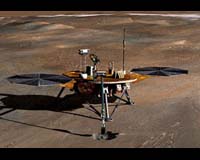
Tucson AZ (SPX) Oct 18, 2006 - Phoenix Mars Mission Principal Investigator Peter Smith will unveil a full-scale Mars lander this Friday at a VIP celebration at the Phoenix Mars Mission Science Operations Center in Tucson. University of Arizona engineers will use the mock lander on its Mars-looking platform to test instruments and commands. Scientists will practice operations in the PIT (Payload Interoperability Testbed), where the lander resides, before performing them for real on Mars.

Legacy Reports

Is It Time For A New Martian Chronology

Moffett Field CA (SPX) Oct 17, 2006 - The classic technique for assessing the history of a rocky planet's geology is to count craters. On average, areas with longer exposure to space have had more impacts, and therefore more craters. By counting craters, scientists have broken the geologic history of Mars into three eras: Noachian (warm and wet), Hesperian (volcanic), and the present-day Amazonian (cold and dry). Following Earthly practice, each era is named for the location where the characteristic terrain was first identified.

Legacy Reports

Mars Express And The Story Of Water On Mars

Paris, France (SPX) Oct 17, 2006 - For a number of decades now, astronomers have wondered about water on Mars. Thanks to ESA's Mars Express, much of the speculation has been replaced with facts. Launched on 2 June 2003, Mars Express has changed the way we think of Mars. Since the Viking missions of the 1970s, planetary scientists have changed their perception of water on Mars several times, passing from the picture of a dry planet to that of a warmer and wetter one.

Legacy Reports

NASA Orbiter Reveals New Details Of Mars Both Young And Old

Pasadena CA (SPX) Oct 17, 2006 - During its first week of observations from low orbit, NASA's newest Mars spacecraft is already revealing new clues about both recent and ancient environments on the red planet. Scientists hope the Mars Reconnaissance Orbiter will answer questions about the history and distribution of Mars' water by combining data from the orbiter's high-resolution camera, imaging spectrometer, context camera, ground-penetrating radar, atmospheric sounder, global color camera, radio and accelerometers.