The new frontier of exploration.
Mars Daily Editorial Team
Editorial Team

Mars Daily Editorial Team

Editorial Team

The Mars Daily Editorial Team produces Mars Daily's coverage of Mars exploration and science. We report on rovers and orbiters, sample-return and human-Mars planning, and the geology, atmosphere and astrobiology of the Red Planet. Articles reflect our team's collective editorial process, source verification, drafting, technical review, and editing, rather than a single writer's work. Mars Daily takes editorial responsibility for content under this byline. For more on how we work, see our editorial policy.

Legacy Reports

Arizona State Scientists Keep An Eye On Martian Dust Storm

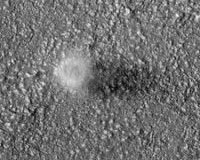
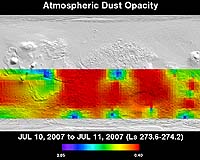
Tempe AZ (SPX) Jul 13, 2007 - Scientists at Arizona State University's Mars Space Flight Center are using the Thermal Emission Imaging System (THEMIS) on NASA's Mars Odyssey orbiter to monitor a large dust storm on the Red Planet. The instrument, a multi-wavelength camera sensitive to five visible wavelengths and 10 infrared ones, is providing Mars scientists and spacecraft controllers with global maps that track how much atmospheric dust is obscuring the planet.

Legacy Reports

NASA Readies Mars Lander For August Launch To Icy Site

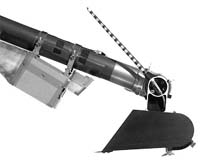
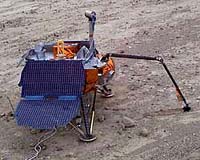
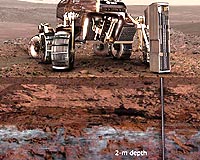
Washington DC (SPX) Jul 10, 2007 - NASA's next Mars mission will look beneath a frigid arctic landscape for conditions favorable to past or present life. Instead of roving to hills or craters, NASA's Phoenix Mars Lander will claw down into the icy soil of the Red Planet's northern plains. The robot will investigate whether frozen water near the Martian surface might periodically melt enough to sustain a livable environment for microbes. To accomplish that and other key goals, Phoenix will carry a set of advanced research tools never before used on Mars.

Legacy Reports

Spirit Solar Power Levels Continue To Rise

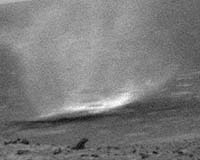
Pasadena CA (JPL) Jul 06, 2007 - Spring cleaning continued on NASA's Spirit rover, as atmospheric turbulence on Mars cleared away more dust from the solar panels on the rover's 1,233rd sol, or Martian day, of exploration (June 22, 2007). As a result of this most recent dust-clearing event, Spirit out-produced the electrical energy of Spirit's twin, the Opportunity rover on the opposite side of Mars, by about 50 watt-hours. (That's the amount of electricity needed to burn a 50-watt light bulb for one hour.)

Legacy Reports

An Opportunity For A One-Way Trip To The Bottom Of Crater Victoria

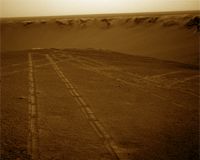
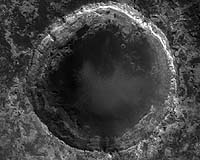
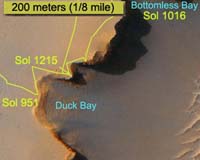
Pasadena CA (JPL) Jul 06, 2007 - NASA's Mars rover Opportunity is scheduled to begin a descent down a rock-paved slope into the Red Planet's massive Victoria Crater. This latest trek carries real risk for the long-lived robotic explorer, but NASA and the Mars Rover science team expect it to provide valuable science. Opportunity already has been exploring layered rocks in cliffs around Victoria Crater. The team has planned the descent carefully to enable an eventual exit, but Opportunity could become trapped inside the crater or lose some capabilities. The rover has operated more than 12 times longer than its originally intended 90 days.

Legacy Reports

Spirit Independently Approaches And Studies A Rock

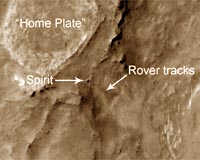
Pasadena CA (JPL) Jul 06, 2007 - Spirit remains healthy after attempting to wrap up scientific studies on an outcrop that contains several tantalizing, high-silica targets. High-silica targets are of interest to scientists because water might have been involved in forming them. Spirit still has some work to do on two targets, known as Eileen Dean and Innocent Bystander, before moving on to the elevated, circular plateau known as Home Plate.

Legacy Reports

Dust Delays Mars Crater Entry

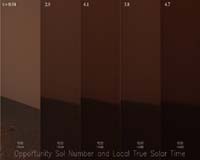
Pasadena CA (JPL) Jul 06, 2007 - A giant dust storm brewing for more than a week on Mars has become worse and is affecting surface operations of the Mars Exploration Rovers, Spirit and Opportunity. Because the rovers depend on solar energy for survival, and the dust is partially blocking the sun, the storm is being watched closely by the rover scientists and engineers. Opportunity's entry into Victoria Crater is delayed for at least several days.

Legacy Reports

Seeking Mars Survival Secrets

Princeton NJ (SPX) Jul 06, 2007 - David Smith always wondered whether other planets might harbor life, so when he actually got the opportunity to investigate, he jumped at it. His decision launched him on a year-long mission, leading him to the Kennedy Space Center and back. Now, after months exploring whether Earth bacteria can survive on the surface of Mars, he has returned with findings that could help NASA plan better missions to the red planet.

Legacy Reports

Scientists Find That Earth And Mars Are Different To The Core

Oxford UK (SPX) Jul 06, 2007 - Research comparing silicon samples from Earth, meteorites and planetary materials, published in Nature (28th June 2007), provides new evidence that the Earth's core formed under very different conditions from those that existed on Mars. It also shows that the Earth and the Moon have the same silicon isotopic composition supporting the theory that atoms from the two mixed in the early stages of their development. This latest research which was carried out by scientists from Oxford University along with colleagues from University of California, Los Angeles (UCLA) and the Swiss Federal Institute of Technology in Zurich (ETH) compared silicon isotopes from rocks on Earth with samples from meteorites and other solar system materials.

Legacy Reports

One Image Planned During Descent Of Phoenix

Pasadena CA (JPL) Jul 06, 2007 - Extensive testing of NASA's Phoenix Mars Lander in preparation for an August launch has uncovered a potential data-handling problem in time to modify plans for use of a camera during the final minutes of arrival at Mars. The testing results led to a decision to take just one photograph with the spacecraft's Mars Descent Imager. The mission will still be capable of accomplishing all of its science goals. The issue is not the camera itself, which is capable of taking multiple downward-looking images of the landing area during the final three minutes of flight.

Legacy Reports

ESA Wants Space Pioneers For 520-Day Mars Experiment

Le Bourget, France (AFP) June 19, 2007 - The European Space Agency (ESA) on Tuesday called for applications for one of the most demanding human experiments in space history: a simulated trip to Mars in which six astronauts will spend 17 months in an isolation tank on Earth. Their spaceship will comprise a series of interlocked modules in an research institute in Moscow, and once the doors are closed tight, the volunteers will be cut off from all contact with the outside world except by a delayed radio link.