
The new frontier of exploration.
Mars Daily Editorial Team
Editorial Team

Mars Daily Editorial Team

Editorial Team

The Mars Daily Editorial Team produces Mars Daily's coverage of Mars exploration and science. We report on rovers and orbiters, sample-return and human-Mars planning, and the geology, atmosphere and astrobiology of the Red Planet. Articles reflect our team's collective editorial process, source verification, drafting, technical review, and editing, rather than a single writer's work. Mars Daily takes editorial responsibility for content under this byline. For more on how we work, see our editorial policy.

Legacy Reports

ESA Wants Space Pioneers For 520-Day Mars Experiment

Le Bourget, France (AFP) June 19, 2007 - The European Space Agency (ESA) on Tuesday called for applications for one of the most demanding human experiments in space history: a simulated trip to Mars in which six astronauts will spend 17 months in an isolation tank on Earth. Their spaceship will comprise a series of interlocked modules in an research institute in Moscow, and once the doors are closed tight, the volunteers will be cut off from all contact with the outside world except by a delayed radio link.

Legacy Reports

Simulating The Effects Of Martian Dust On The Phoenix Lander

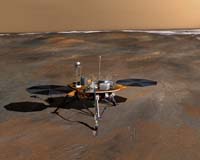
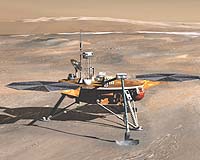
Ann Arbor MI (SPX) Jun 15, 2007 - Gusting winds and the pulsating exhaust plumes from the Phoenix spacecraft's landing engines could complicate NASA's efforts to sample frozen soil from the surface of Mars, according to University of Michigan atmospheric scientist Nilton Renno. Set to launch Aug. 3 from Florida, the $414 million Phoenix Mars Lander will use descent engines to touch down on the northern plains, where vast stores of ice have been detected just below the surface.

Legacy Reports

Wandering Poles May Explain Ups And Downs Of Ancient Mars Shoreline

Berkeley CA (SPX) Jun 13, 2007 - A paper in this week's issue of Nature by University of California, Berkeley, geophysicists demolishes one of the key arguments against the past presence of large oceans on Mars. Even from Earth, a large plain surrounding the planet's north pole looks like a sediment-filled ocean basin. In the 1980s, Viking spacecraft images revealed two possible ancient shorelines near the pole, each thousands of kilometers long with features like those found in Earth's coastal regions.

Legacy Reports

The Viability Of Methane-Producing Microorganisms In Simulated Martian Soils

Fayetteville AK (SPX) Jun 11, 2007 - University of Arkansas researchers have tested the methane production of three different types of microorganisms in different soil types that resemble those found on Mars to test the possibility of these soils harboring life. Tim Kral, professor of biological sciences at the University of Arkansas; Heaven A. Kozup of Gwynedd-Mercy College in Pennsylvania, and UA graduate student Brandon G. Gibson will present their findings Wednesday, May 23, at the American Society for Microbiology in Toronto.

Legacy Reports

Taking The Opportunity To Evaluate New Driving Capabilities

Pasadena CA (JPL) Jun 09, 2007 - Opportunity performed on sol 1194 a Visual Target Tracking (VTT) technology checkout (drive software) on a target called Paloma. This VTT checkout tested VTT in combination with other drive software, Autonav and Visodom. The first segment was a blind (no Autonav or Visodom) VTT drive to back away from the target. The second segment combined VTT and Visodom to drive towards the target. The third segment combined VTT and Autonav to continue driving towards the target.

Legacy Reports

THEMIS Marks Milestone In Imaging Mars

Tempe, AZ (SPX) Jun 08, 2007 - The Thermal Emission Imaging System (THEMIS) aboard NASA's Mars Odyssey orbiter marked a milestone May 4. An image from THEMIS showing Martian lava flows and wind streaks mingling with impact craters, became the 1,200th Image of the Day posted online. The Mars Space Flight Facility at ASU operates the site, which is updated every weekday with images and data from THEMIS. The first Image of the Day was posted March 27, 2002.

Legacy Reports

HiRISE Releases Thouands Of New Images Of Mars Via New Website Viewer

Tucson AZ (SPX) Jun 05, 2007 - Anyone connected by Internet can now see planet Mars better than at any time in history, through the eye of HiRISE, the most powerful camera ever to orbit another planet. A University of Arizona-based team that runs the High Resolution Imaging Experiment (HiRISE) camera on NASA's Mars Reconnaissance Orbiter has just released more than 1,200 Mars images to the Planetary Data System, the U.S. space agency's mission data archive.

Legacy Reports

The Spirit Of Mars Continues To Astonish

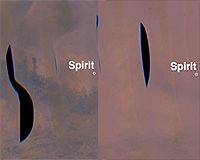
Pasadena CA (JPL) Jun 01, 2007 - Spirit is still making new discoveries despite dragging its feet, so to speak, after losing use of the right front wheel 426 sols, or Martian days, ago. In the process of creating small trenches while traversing Martian terrain, the dragging right front wheel revealed one of the most astonishing discoveries so far -- exceptionally high silica content in Martian soil, indicative of water at some point in the past.

Legacy Reports

Mars Science Laboratory Less Than A Year From Assembly And Testing Phase

Pasadena CA (JPL) May 30, 2007 - The 2009 Mars Science Laboratory, the mammoth grandchild of the 1997 Sojourner rover, is less than one year from the assembly, test and launch operations phase (ATLO). With its immense increase in size comes advanced abilities in power, technology and science data collection. In early 2008, the team will start the flight vehicle assembly and testing, simulating on earth every challenge the brave new traveler will face during the mission.

Legacy Reports

Spirit Continues Soil Analysis

Pasadena CA (SPX) May 28, 2007 - Spirit is healthy and spent the last week studying light and dark soil in and around the rover's tracks between Home Plate and Mitcheltree Ridge. Spirit collected additional soil data, including about 24 hours of data using the alpha-particle X-ray spectrometer and 70 hours of data using the Mossbauer spectrometer. The primary soil targets examined during the week are known as Kenosha Comets and Lefty Ganote.