
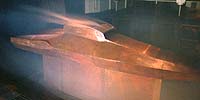
NASA today convened a board to determine the cause of Saturday's loss of the first X-43A unpiloted hypersonic research aircraft.
Gathering at NASA's Dryden Flight Research Center, Edwards Calif., the board consists of members from other agency centers, including:
Robert Hughes, chairman, Marshall Space Flight Center, Huntsville, Ala.,
John J. Deily, Goddard Space Flight Center, Greenbelt, Md.,
Joseph J. Lackovich Jr., Kennedy Space Center, Fla.,
Victoria A. Regenie, Dryden Flight Research Center,
Luat T. Nguyen, Langley Research Center, Hampton, Va.
The mated X-43A and its booster rocket went out of control about eight seconds after ignition of the Pegasus motor during the June 2 launch over the Pacific Ocean off the California coast.
The booster was intentionally destroyed using onboard flight-termination explosives, and fell safely in a cleared Navy sea range. There were no injuries and no damage to other aircraft or property.
This mission was the first of three flights to demonstrate an airframe-integrated, "air-breathing" propulsion system design, called a scramjet, which so far has only been tested in ground facilities, such as wind tunnels.
