
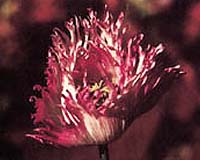
The United States is winding down efforts to destroy poppy in Afghanistan, the US regional envoy said Wednesday, after criticism that the zealous US approach has pushed peasants toward the Taliban.
Richard Holbrooke, the special envoy for Afghanistan and Pakistan, said that President Barack Obama's administration was making "significant adjustments" from the previous George W. Bush team in a bid to root out Islamic extremism.
"We are downgrading our efforts to eradicate crops — spraying — a policy we think is totally ineffectual," Holbrooke testified before Congress.
He said the money spared would be devoted to stopping trafficking, pursuing drug lords and helping farmers grow other crops.
"We're not downgrading narcotics, we're downgrading crop eradication," Holbrooke said.
Afghanistan supplies 90 percent of the world's heroin, much of which emanates from the southern province of Helmand, where Taliban-led insurgents are waging a bloody campaign against Western and Afghan forces.
Critics, even within the NATO-led coalition in Afghanistan, have feared that the United States was pushing impoverished peasants into the Taliban by destroying their key cash crop while funding the extremists.
"Hundreds and hundreds of millions of dollars we've spent on crop eradication has not done any damage to the Taliban. On the contrary, it's helped them recruit," Holbrooke said.
"In my experience," the veteran US diplomat and negotiator said, "this is the least effective program ever."
Holbrooke said that the Obama administration was also ramping up agricultural aid to provide Afghans with alternative livelihoods.
But his view was challenged by Representative Mark Souder, a member of Bush's Republican Party, who said Afghanistan was already "the breadbasket of the world" until poppy became more lucrative.
"There has to be some disincentive to plant heroin in addition to an incentive to plant other crops," Souder said.
"It will not suffice to say, 'Plant corn,' when you can get incredible amounts more dollars" with poppy, he said.
General Chip Gregson, the assistant secretary of defense for Asia, said the long-term solution was to improve security and infrastructure in Afghanistan to allow more legitimate agriculture.
"Eradication by itself hurts the farmers," Gregson told the hearing. "The people who are making money off the drug trade are not the subsistence farmers — they are the middlemen."
The Taliban had clamped down on opium production when it imposed its austere brand of Islam on Afghanistan during its five-year rule, which ended in a US-led military operation after the September 11 attacks.
But opium production has since soared into an industry estimated by some experts to be worth 100 million dollars a year, providing a major source of funding for the Taliban.
US military authorities acknowledge that an eight-year anti-drug effort in Afghanistan has failed to step the heroin trade.
In October last year, NATO nations for the first time authorized the international force in Afghanistan to take action against drug traffickers and their facilities.
Share This Article With Planet Earth
