
The United States has put South Korea and China on the spot by heightening financial sanctions on North Korea and simultaneously pushing for the Stalinist state to return to nuclear talks.
Pyongyang says it would not return to the six-party talks unless the United States lifts the sanctions in retaliation for North Korea's alleged counterfeiting and money laundering activities.
Washington has refused to budge, saying it cannot compromise with "criminal activity", now posing a major challenge to talks host China and neighbour South Korea to woo back North Korea to the negotiating table.
The United States also raised the stakes by pressuring South Korea, which is rapidly building ties with North Korea, to impose a financial squeeze on its northern neighbour in a bid to force it to abandon its alleged counterfeiting of US dollar notes.
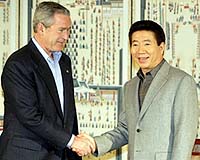
In a rare outburst, South Korean President President Roh Moo-Hyun warned Wednesday of friction developing with the United States if it continued to put pressure on North Korea.
South Korea is torn between appeasing its key ally, the United States, and building bridges with its neighbour half a century after the Korean War.
Beijing is under pressure to revive the six-party talks, stalled since November, as it would pave the way for a warm US welcome for Chinese President Hu Jintao when he visits Washington in April.
"This issue is only a skirmish in preparation for a huge battle — over whether North Korea is willing to give up its nuclear weapons," said Richard Bush, head of Northeast Asian policy studies at Brookings Institution, a Washington-based think tank.
He said that China, North Korea's biggest ally and supplier of desperately needed aid, and South Korea, should tell North Korea to stop linking counterfeiting to the nuclear talks, which involve the three and the United States, Japan and Russia.
The expert acknowledged that it was legitimate for China and South Korea to want to be assured that there was a basis to the financial sanctions.
"But now that we have taken steps to assure them that there is a basis, I would hope that they would say to North Korea, 'you have no reason to hold up the resumption of the six-party talks which concerns totally separate issues, and by the way, counterfeiting another country's currency is an act of bad faith,'" he said.
Some wonder why the United States, having highlighted North Korea's contraband trade for years, imposed the sanctions at a critical juncture of the nuclear talks, especially after North Korea has agreed in principle to abandon its atomic weapons for diplomatic, security and aid guarantees.
"I know from my time in government that there is never a good time to take an action that someone will perceive as a hostile act. You can always come with a reason why it is a bad time to do it," said Bush, a former national intelligence officer.
US Treasury officials visited Seoul this week to try to convince South Korean officials that North Korea was guilty of counterfeiting US currency and money-laundering. The visit is part of an Asian trip also covering Hong Kong, Macau, Beijing and Tokyo to highlight US concerns about alleged illicit North Korean financial and drug activities.
The Treasury in September labelled a Macau-based bank Banco Delta Asia a "primary money laundering concern" and then blacklisted eight North Korean companies in connection with the bank that it said were involved in spreading weapons of mass destruction.
North Korea pockets up to one billion dollars a year from counterfeiting US greenbacks, trafficking illicit narcotics, smuggling contraband smokes and even peddling knockoff Viagra, according to US government estimates.
"I don't think we should turn a blind eye to these important issues just because we are dealing with the nuclear issue," said Peter Brookes, a former US deputy assistant secretary of defense.
"Is it okay for North Korea to traffic heroin and pollute societies just because they want to get into the table to talk about nuclear weapons," he asked.
Source: Agence France-Presse
