
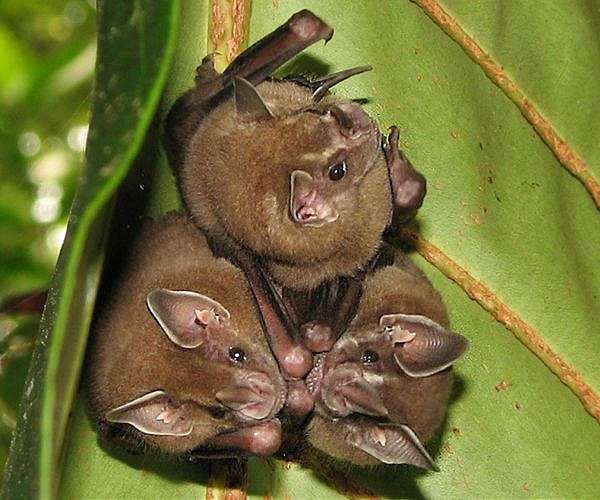
The U.S. Fish and Wildlife Service on Tuesday reclassified the northern long-eared bat as an endangered species, calling the need to increase the protection level for the species an "alarm bell."
The agency on Tuesday announced the new classification under the Endangered Species Act will begin on Jan. 30, 2023, as the species faces extinction due to a deadly disease known as white-nose syndrome.
"This listing is an alarm bell and a call to action," U.S. Fish and Wildlife Service Director Martha Williams said in a statement. "White-nose syndrome is decimating cave-dwelling bat species like the northern long-eared bat at unprecedented rates."
White-nose syndrome is caused by the growth of a fungus affecting bats' muzzles and wings. The fungus thrives in cold, dark, damp places like the caves they inhabit and infects bats during hibernation
Bats are the only species of wildlife known to be affected by white-nose syndrome, which has been confirmed in 38 states and eight Canadian provinces.
The disease has now spread across nearly 80% of the species' entire range and is expected to affect 100% of the species' range by the end of the current decade.
The northern long-eared bat is found in 37 U.S. states and eight Canadian provinces in North America and was classified as threatened in 2015. The bat typically measures between 3 and 3.7 inches in length, with a wingspan of 9 to 10 inches, and feeds primarily on moths, beetles and flies.
Habitat loss and what the department calls "wind energy-related mortality," typically referring to deaths caused by windmills, are also contributing to the decline in numbers.
Authorities are attempting to help the bat's population recover before it becomes critically endangered or extinct.
"The Service is deeply committed to working with partners on a balanced approach that reduces the impacts of disease and protects the survivors to recover northern long-eared bat populations," Williams said.
Bats play a critical role in healthy, functioning natural areas. They contribute at least $3 billion annually to the American agriculture economy through pest control and pollination, according to the Fish and Wildlife Service.
The new classification from endangered to threatened nullifies previous exceptions given to protected areas and the department acknowledged the change could affect compliance for forestry, wind energy, infrastructure and other projects in the range of the northern long-eared bat.
Projects that have already gotten environmental approval assessments will be allowed to go ahead as scheduled.
Scientists in Peru discover two new endangered plant species
Lima (AFP) Nov 30, 2022 –
A group of Peruvian and international botanists has discovered two new species of plant that are endangered by mining activity in the Peruvian Andes, the University of San Marcos reported Tuesday.
The new species, named "Viola ornata" and "Viola longibracteolata," belong to the Neo-andinium subgenus of Viola, which in Peru currently has 15 species.
"San Marquino botanists are publishing a study in which they reveal two new species of plants found in Arequipa and Moquegua, and which are in critical danger due to mining activity," the university said in a statement.
This subgenus brings together species that are mostly found inhabiting the Andes, at extremely high altitudes, in remote areas little explored between 12,500 and 16,400 feet (3,800 and 5,000 meters) above sea level.
The new species are perennial herbs, quite hairy in appearance, that grow in rosettes with small flowers, and their coloration and shape help them blend them with their environment.
"The conservation status of both new species is critically endangered, mainly due to the decrease in the quality of their current and potential habitats, since these areas are seriously impacted by extensive mining exploitation," the statement added.
The plants were recently found in the high Andes in the Moquegua and Arequipa regions, in the south of the country.
