
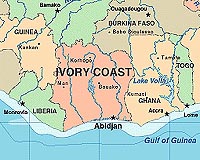
The UN Security Council Thursday renewed for a year an arms and diamond embargo on Ivory Coast, hoping it can be lifted after free and fair elections are held in the divided nation.
The resolution, identical to last year's, passed by unanimous vote in the 15-member council. First imposed in 2005, the embargo on weapons and on trade in rough diamonds from the west African nation now extends to October 31, 2010.
It also extends travel restrictions targeting Ivorian political figures and a freeze on their foreign assets.
Drawn up by France, the resolution calls for an embargo review "in light of the progress achieved in the electoral process and in the implementation of the key steps of the peace process."
Specifically, the review is to kick in "no later than three months after the holding of open, free, fair and transparent presidential elections in accordance with international standards."
The council warned that more sanctions would be considered if the electoral process in Ivory Coast is threatened.
"In particular any attack or obstruction of the action of the Independent Electoral Commission in charge of the organization of the elections… shall constitute a threat to the peace and national reconciliation process," the resolution said.
Many times delayed since 2005, the country's presidential elections are seen as essential to end the political-military crisis that began after a failed September 2002 coup against President Laurent Gbagbo.
On Wednesday, a close ally to Gbagbo said it was not possible to organize presidential elections by the scheduled date of November 29, indicating yet another delay.
In disapproving the embargo extension, Ivory Coast's Ambassador to the United Nations Alicide Djedje said that circumstances in his country had changed.
"The former belligerents… have reconciled… and there's no reason why individual sanctions should be maintained."
Gbagbo's mandate ran out in 2005 while his country was divided between the government-held south and the north, held by rebel New Forces, who had tried to oust him in 2002.
Gbagbo came to power in 2000 and has made peace with the New Forces, headed by Prime Minister Guillaume Soro, but he still only presides over half of the cocoa-rich nation. The rest remains in the hands of the former rebels.
Share This Article With Planet Earth
