
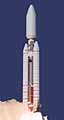
The Air Force and Lockheed Martin Astronautics launch team is set to launch a Titan IV/B rocket carrying a Defense Support Program spacecraft from Space Launch Complex 41 here April 9.
Air Force Space Command-operated DSP satellites are a key part of North America's early warning systems. In their 19,320-mile geosynchronous orbits, DSP satellites help protect the United States and its allies by detecting missile launches, space launches and nuclear detonations.
This will be the final Titan IV launch from Complex 41. The complex is being deactivated and turned over to Lockheed Martin for the company's evolved expendable launch vehicle program. It will take 150 days to deactivate the pad. This includes work such as draining, purging, and cleaning propellant and propane storage tanks. Lockheed Martin Astronautics plans to dismantle and remove the mobile service tower, umbilical tower and most of the ground-support equipment. It will then install new ground equipment to support the Atlas V — its EELV.
"There is a lot of history at Complex 41," said Brig. Gen. Randy Starbuck, 45th Space Wing commander. "In addition to our military launches, this is where we launched two Viking missions to Mars, and sent the two Voyager satellites to visit the outer planets. But, our primary concern is to get this mission launched safely. It takes an incredibly talented team of professionals to make this happen."
The launch marks the return to flight of the Titan IV from here after the Aug. 12 mishap involving a Titan IV/A carrying a National Reconnaissance Office satellite. It was the last scheduled launch for the "A" model.
The results of the accident investigation board inquiry indicated electrical shorts in the vehicle power supply wiring harness most likely caused the vehicle to catastrophically fail 41 seconds into powered flight. The shorts originated in the second stage of the core vehicle.
"We have had an accident, we determined the most likely cause, and we implemented corrective actions," said Lt. Col. Anthony Goins, 3rd Space Launch Squadron commander. "From the technicians on the pad to the senior levels of the Air Force, the attitude is now 'it's time to go fly.'"
