
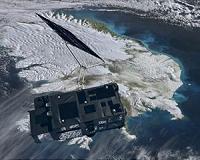
Thales Alenia Space is celebrating signing a contract worth 450 million euro with the European Space Agency (ESA), to build the Sentinel-3C and D environmental monitoring and oceanographic satellites for the European programme Copernicus.
Thales Alenia Space is once again prime contractor for these two new satellites, as it was for the Sentinel-3A and 3B satellites, with responsibility for design, development, integration and testing.
These satellites are compatible with the European light launcher, Vega, and will each be fitted with four main instruments:
– Two optical instruments: one dedicated to the colour of the oceans, OLCI (Ocean and Land Colour Instrument), and a Sea and Land Surface Temperature Radiometer (SLSTR)
– Two radar instruments: a Synthetic aperture Radar ALtimeter (SRAL) and a MicroWave Radiometer (MWR), used to provide versatile capability of surface topography measurements with primary mission over the oceans but also offering sea ice, ice and inland waters and land capabilities.
Scheduled for launch from 2021, the Sentinel-3C and 3D satellites are an integral part of Europe's vast Earth observation programme Copernicus (formerly known as GMES), managed by ESA in partnership with the European Commission.
Copernicus aims to ensure European independence in the acquisition and management of our planet's environmental data to provide support for Europe's authorities and decision-makers.
Each Sentinel-3C and 3D satellite will weigh approximately 1.2 metric tonnes at launch, and will be positioned in Low Earth Orbit (LEO) at an altitude of 815 kilometres.
The main objective of the Sentinel-3 mission is the global observation of oceans and land, including their "colour" and temperature, along with a precise measurement of ocean levels. ESA's Sentinel programmes include six families of satellites, each fitted with instruments for their specific missions. Sentinel-3 will ensure continuity with the optical observation data provided by Envisat.
Sentinel-3A, scheduled for launch in mid-February 2016, will mark the start of this operational service. Sentinel- 3B is now being integrated at Thales Alenia Space's facility in Cannes, France, and is scheduled for launch in mid-2017.
"We are extremely proud of winning this major contract, which confirms Thales Alenia Space's longstanding expertise in the manufacture of Earth observation satellites and instruments," said Jean- Loic Galle, CEO of Thales Alenia Space. "Our selection by ESA also shows that we have the capabilities needed to meet the technological challenges of this programme, while making a major contribution to Europe's environmental protection strategy, today and for years to come."
Along with Europe's leading role in this sector, France and Thales Alenia Space, with significant backing from French space agency CNES, play a pivotal role in Earth observation programmes. For example, Thales Alenia Space has been in charge of all generations of Meteosat meteorology satellites, the very successful series of Jason climatology/oceanography satellites, the third of which was launched on January 17, 2016, and the family of IASI interferometers, used for atmospheric monitoring.
