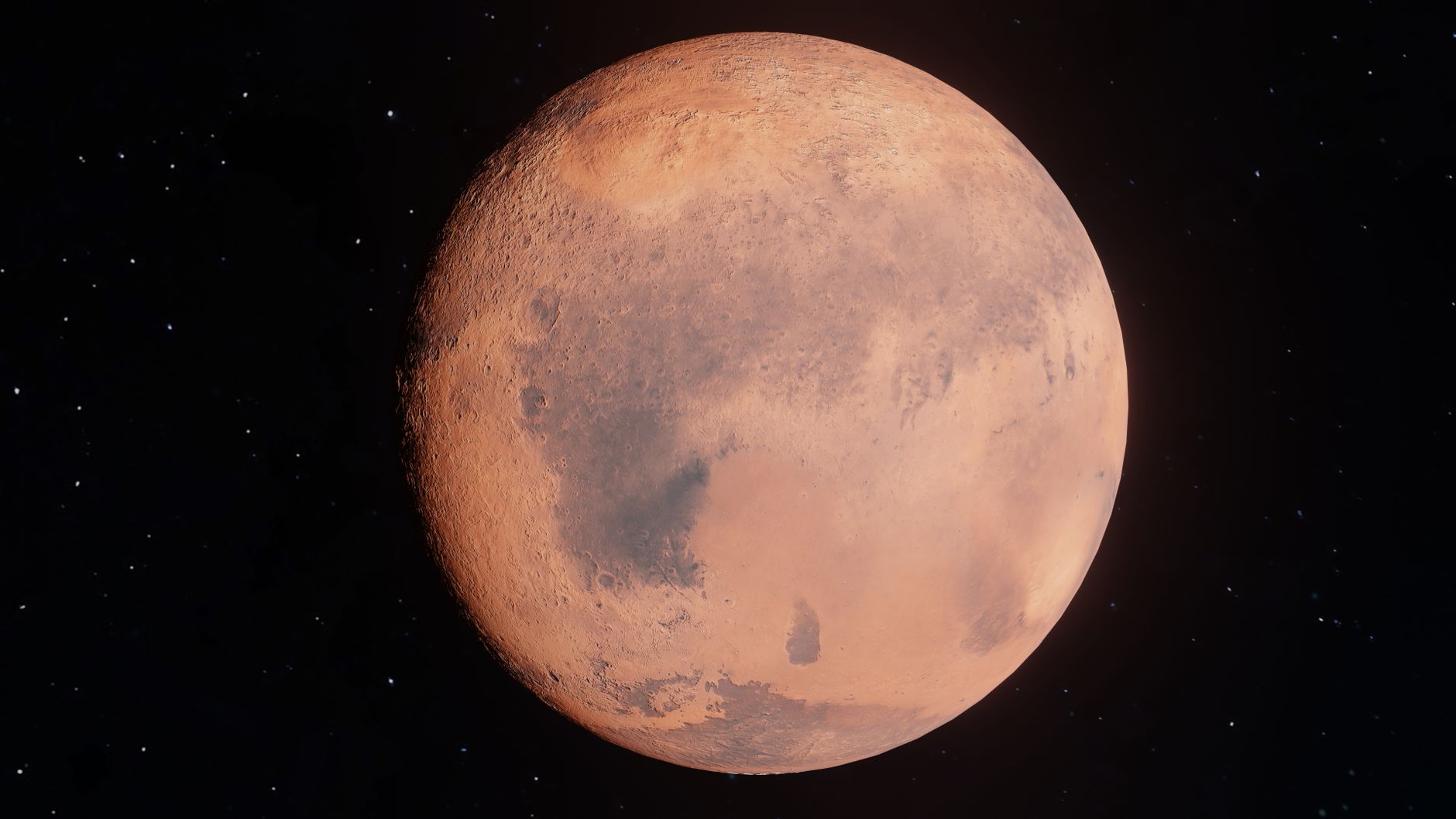
Mars presents us with two planets at once. The first is the one visible today: cold, dry and wrapped in an atmosphere with less than one hundredth of the surface pressure found on Earth. The second survives in stone. Branching valleys cross old terrain, deltas spread into empty basins, and layers of mudstone record lakes that endured long enough to sort and settle sediment.
The evidence points to an early Mars with far more surface water and a thicker atmosphere. The planet also once generated a global magnetic field from its interior. When that internal dynamo faded, Mars lost the large magnetic shield that had kept much of the solar wind at a distance. The upper atmosphere became more directly exposed, and over immense spans of time the Sun helped carry away gases that had made surface water possible.
That is the useful short version. The more accurate version is also more interesting. Mars did not change when a single switch was thrown. A magnetic field is not a perfectly sealed lid, and the solar wind was not the only agent at work. The history joins geology, planetary cooling, ultraviolet radiation, atmospheric chemistry and Mars’s relatively weak gravity.
The old climate is written into the ground
The case for ancient water does not rest on one suggestive landform. NASA’s summary of Martian geology describes river valleys, deltas, lakebeds, and rocks and minerals that form in liquid water. Together, those records show water moving across the surface, entering basins and altering the material it touched.
Curiosity supplied an especially clear view inside Gale Crater. The rover found rounded gravel transported by flowing water, then finely layered mudstones formed as sediment settled to a lake floor. In 2015, the rover team reported evidence for a succession of streams and lakes between roughly 3.8 and 3.3 billion years ago. Perseverance later landed beside another part of the same history at Jezero Crater, where an ancient river built a delta into a lake.
Calling this world “warmer” does not require imagining a permanently temperate Mars. The young Sun was fainter than it is now, and climate models have difficulty maintaining warm global conditions for millions of years using carbon dioxide alone. Ancient Mars may have been mostly cold, interrupted by wetter episodes driven by snowmelt, rainfall, volcanism, impacts or combinations of those effects. The rocks nevertheless require conditions in which liquid water remained on the surface far more readily than it can today.
Mars once ran an internal dynamo
A planetary dynamo turns motion inside a conductive fluid core into a global magnetic field. Earth still runs one in its liquid outer core. Mars does not. Its ancient crust, however, contains strong patches of remanent magnetism, particularly across the southern highlands. That magnetism is difficult to explain unless rocks cooled in the presence of a powerful early field and preserved a record of it.
The later record is patchier. Some younger terrain and large impact basins do not show the same strong magnetisation. A 2021 analysis by planetary scientist D. J. Hemingway in the Journal of Geophysical Research: Planets described the crustal evidence as a strong indication that an early dynamo eventually shut down, while examining how the cooling history of the core could account for that change.
There is no single agreed date for the dynamo’s death. Estimates depend on the ages of magnetised rocks and impact basins, and some evidence may point to intervals of activity later than a simple early shutdown would suggest. Nor is Mars magnetically blank today. Magnetised crust creates local fields, while the interaction between the solar wind and the ionosphere produces an induced magnetic environment. What Mars lacks is an internally generated field enveloping the planet.
What the solar wind does to an exposed atmosphere
The solar wind is a stream of charged particles carrying magnetic fields away from the Sun. When it reaches Mars, those particles and fields interact with the ionised upper atmosphere. Some atmospheric ions are accelerated into space. In another process called sputtering, energised ions strike neutral atoms and molecules, transferring enough energy to knock them out of the atmosphere. Solar ultraviolet light also heats the upper air and breaks molecules apart, enabling thermal and photochemical escape.
NASA sent the Mars Atmosphere and Volatile Evolution spacecraft, or MAVEN, to separate and measure these routes. The mission studied the upper atmosphere from 2014 until NASA declared it ended in June 2026, after contact had been lost the previous December. MAVEN observed present-day escape, watched rates respond to solar storms and measured the isotope fingerprints left by past losses.
Argon offered a particularly clean tracer because it is chemically inert and is not readily hidden in Martian rocks. Lighter isotopes escape more easily than heavier ones. From the imbalance left behind, a team led by Bruce Jakosky reported in Science in 2017 that about 65 percent of the argon once present had been lost to space. Argon is not the main greenhouse gas, but its isotopes preserve evidence that physical escape removed a large share of the atmosphere.
MAVEN eventually caught one of those mechanisms in action. In a 2025 Science Advances paper, Shannon Curry and colleagues reported the first direct observation of atmospheric sputtering at Mars. By combining measurements from three instruments, the team mapped argon atoms at high altitude to the places where energetic particles were striking the atmosphere. The measured sputtering rate was four times higher than earlier predictions and rose during solar storms, according to NASA’s account of the result.
Small losses become a changed planet
Mars is still losing gas, but the present rate alone does not describe the past. The young Sun emitted stronger extreme ultraviolet radiation and was more active. The escape mechanisms measured today would therefore have operated differently, and often more strongly, billions of years ago.
In a 2018 synthesis published in Icarus, Jakosky and colleagues used a full Martian year of MAVEN observations to estimate that roughly 2 to 3 kilograms of gas were then escaping each second. Extrapolating the measured processes through the history of solar activity, the authors calculated losses equivalent to as much as 0.8 bar of carbon dioxide and a planet-wide water layer around 23 metres deep. These are reconstructed estimates with model assumptions, not measurements taken from the ancient atmosphere, but they show what persistent leakage can do over geological time.
Not everything went to space. Carbon dioxide can react with rocks and become carbonate minerals. Water can freeze into the subsurface and polar deposits, or become bound in hydrated minerals. Impacts can both remove and deliver volatile material. Mars’s low gravity also matters because an atom needs less energy to escape from Mars than from Earth.
Why the magnetic-shield story needs care
The loss of the dynamo changed Mars’s exposure to the Sun, but it is too simple to say that every atmosphere survives only if a global magnetic field protects it. Venus has no Earth-like internal field and retains a massive atmosphere. Earth has a strong field, yet some ions still escape along magnetic field lines.
Robin Ramstad and Stas Barabash reviewed measurements from Mars, Venus and Earth for a 2021 paper in Space Science Reviews. They argued that a planetary dipole is not automatically required to prevent solar-wind-driven loss and can, under some conditions, increase ion escape. The outcome depends on gravity, atmospheric supply, ultraviolet radiation, wind energy and the strength of the field itself.
For Mars, the dynamo’s shutdown remains an important part of the explanation because it changed the way a small planet’s upper atmosphere interacted with a younger, more active Sun. It was one element in a long transition, not a lone cause. The atmosphere thinned, stable surface water became progressively harder to sustain, and the cold desert expanded.
The result is a planet whose present surface seems to contradict its own geology. It does not. The dry valleys and lake sediments are the durable half of the story. The vanished air was the vulnerable half, removed atom by atom while Mars cooled and the Sun changed above it.