Perseverance did not carry a microphone merely to give Earth a soundtrack. Recordings from the rover have turned sound into a probe of the Martian atmosphere, and one of the first results was unlike anything familiar at sea level on Earth.
The cold, thin carbon dioxide around the rover does not carry every audible frequency at the same effective speed. Measurements published in 2022 placed low-frequency sound near 240 metres per second and higher-frequency sound near 250 metres per second, with the change occurring around 240 hertz. That frequency sits just below middle C, which is approximately 261.6 hertz.
The result means that a high component of a sound can reach a nearby listener before its low component. It does not mean that Martian music would split into clearly separated notes. The difference is small over short distances, while the atmosphere absorbs high frequencies so strongly that much of the treble disappears before it can travel far.
Two sound sources provided the crucial measurements
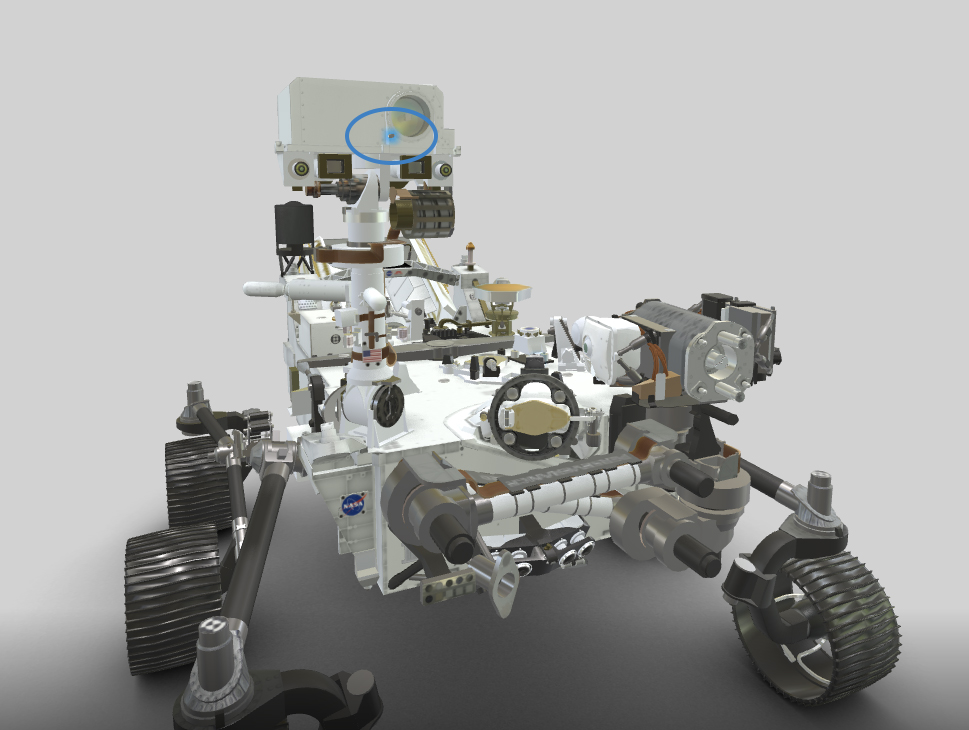
The international team behind the study in Nature analysed recordings made during Perseverance’s first 216 sols on Mars. Most came from the microphone in SuperCam, the instrument package mounted about 2.1 metres above the ground at the top of the rover’s mast.
SuperCam fires a pulsed laser at rocks from distances between roughly 1.5 and seven metres. Each shot creates a tiny plasma, whose rapid expansion launches a sharp acoustic crack. Because the distance between the instrument and its target is known, researchers can use the delay between the laser event and the returning sound to calculate the speed of the pressure wave. Those short cracks contain frequencies above two kilohertz, comfortably within the faster high-frequency regime.
For the lower band, the team used Ingenuity. The helicopter’s counter-rotating blades produced a strong tone near 84 hertz. During its fourth flight, changes in the recorded pitch caused by its motion allowed the researchers to fit the Doppler effect. After accounting for an estimated 2.5-metre-per-second wind along the line between helicopter and rover, they obtained a true sound speed close to 240 metres per second.
The two sources were useful precisely because they sat on opposite sides of the transition. The rotor note supplied a low-frequency reference. The laser sparks supplied brief, high-frequency reference points at known ranges.
Carbon dioxide needs time to respond
Sound is a moving pressure disturbance. Its speed in a gas depends on temperature, molecular mass and how the gas stores and releases energy as it is compressed.
Mars’s atmosphere is dominated by carbon dioxide, at a pressure around 0.6 kilopascals near the rover during the study. Carbon dioxide molecules can store energy in vibrational motion. At relatively low acoustic frequencies, those molecular modes have enough time to respond to each compression and expansion. That changes the gas’s effective heat capacity and lowers the speed of sound.
Above a frequency known as the molecular relaxation frequency, the vibrations cannot keep pace in the same way. The effective thermodynamic response changes, and the pressure wave travels faster. Under the temperature and pressure encountered by Perseverance, the transition lay around 240 hertz.
The boundary is therefore not a rule attached permanently to every place and season on Mars. Temperature, pressure, wind and atmospheric composition matter. Nor is it a perfectly sharp wall separating all bass from all treble. The paper describes two distinct effective values about 10 metres per second apart on either side of a rapid transition under the conditions observed in Jezero Crater.
The treble advantage lasts milliseconds
The phrase “treble arrives before bass” is physically correct, but scale matters. Across ten metres, a wave travelling at 250 metres per second arrives in 0.040 seconds. A wave travelling at 240 metres per second takes about 0.0417 seconds. The difference is roughly 1.7 milliseconds.
Across 100 metres, the gap would grow to about 17 milliseconds, large enough in principle to alter a sharp composite sound. But the faster high-frequency sound is also the part Mars suppresses most severely. NASA’s current guide to the sounds of Mars explains that the thin atmosphere makes sound quieter and absorbs a large share of the higher pitches. The agency’s account of the 2022 study said high tones could be lost entirely over a distance of about eight metres.
At eight metres, the calculated separation between the two speeds is only about 1.3 milliseconds. A person close enough to receive both bands would therefore face a tiny timing difference. Farther away, there may be little treble left to win the race. Dispersion makes the high component faster; attenuation makes it fragile.
Mars is quieter as well as slower
Earth’s atmosphere carries sound near 343 metres per second under ordinary room-temperature conditions. Mars is much colder, and its atmosphere is approximately one hundred times less dense than Earth’s air near the surface. The Nature study calculated that an otherwise comparable source would produce a sound roughly 20 decibels weaker in Martian air.
The high-frequency absorption gives the soundscape a muffled quality. Whistles, bells and birdlike calls would fade especially quickly. Low rumbles can travel farther, although they still move more slowly than sound usually does on Earth. An earlier Mars Daily report on acoustic modelling in Jezero Crater explored the same challenge before Perseverance supplied this direct ground truth.
The quiet helps explain why the acoustic team initially wondered whether the microphone had failed. Between rover mechanisms, wind and laser shots, periods of the recording were nearly silent. Mars has weather, moving machinery and pressure waves, but very little atmosphere with which to turn them into strong sound.
A microphone became an atmospheric instrument
Perseverance carries two microphones. The SuperCam microphone was built for science, including listening to laser impacts to help assess the hardness and physical properties of rocks. A commercial microphone on the rover’s side was added for entry, descent and landing. It did not capture usable audio during the turbulent descent, but survived and recorded sounds after touchdown.
On the ground, the microphones picked up the rover’s wheels, wind, Ingenuity and bursts from a dust-removal tool. The SuperCam recordings also extended measurements of pressure fluctuations into the acoustic range, reaching spatial and time scales inaccessible to earlier Mars weather instruments. Researchers could examine the way turbulent energy dissipated as evening approached and local atmospheric motion became calmer.
That scientific role became especially vivid when the rover directly encountered a dust devil on 27 September 2021. Researchers combined 167 seconds of microphone data with camera images and measurements from the Mars Environmental Dynamics Analyzer to reconstruct the vortex. A separate Nature Communications paper reported the encounter, while Mars Daily covered the first recorded sound of a Martian dust devil.
Engineers can listen too. Changes in a rover’s clicks, motors, wheels or pumps can reveal wear or an emerging mechanical fault, much as a driver notices when a familiar machine begins to sound different.
What a human visitor would actually hear
An unprotected listener cannot stand in Martian air. A crew member would be inside a pressurised suit or habitat, where pumps, fans, solid structures and radio systems would dominate what reached the ear. Conversation outside would travel through communications equipment rather than directly across the atmosphere.
The acoustic measurements still matter for designing microphones, alarms and diagnostic systems. They also establish an experimental benchmark for models of cold, low-pressure carbon dioxide atmospheres, including work relevant to Mars and Venus. Before Perseverance, the predicted frequency-dependent speed had not been measured on the Martian surface.
The phrase “speed of sound” usually suggests one number. Mars shows why that number can conceal molecular behaviour. Below the relaxation range, carbon dioxide has time to take part in the pressure cycle and the wave moves more slowly. Above it, the response changes and the wave moves faster.
Mars really does give low and high tones different effective speeds. The quicker treble, however, has a second problem to overcome: it is also the first part of the soundscape to fade.
Edited by Lachlan Brown