Cheyava Falls is the closest NASA has come to identifying a possible record of ancient life on Mars.
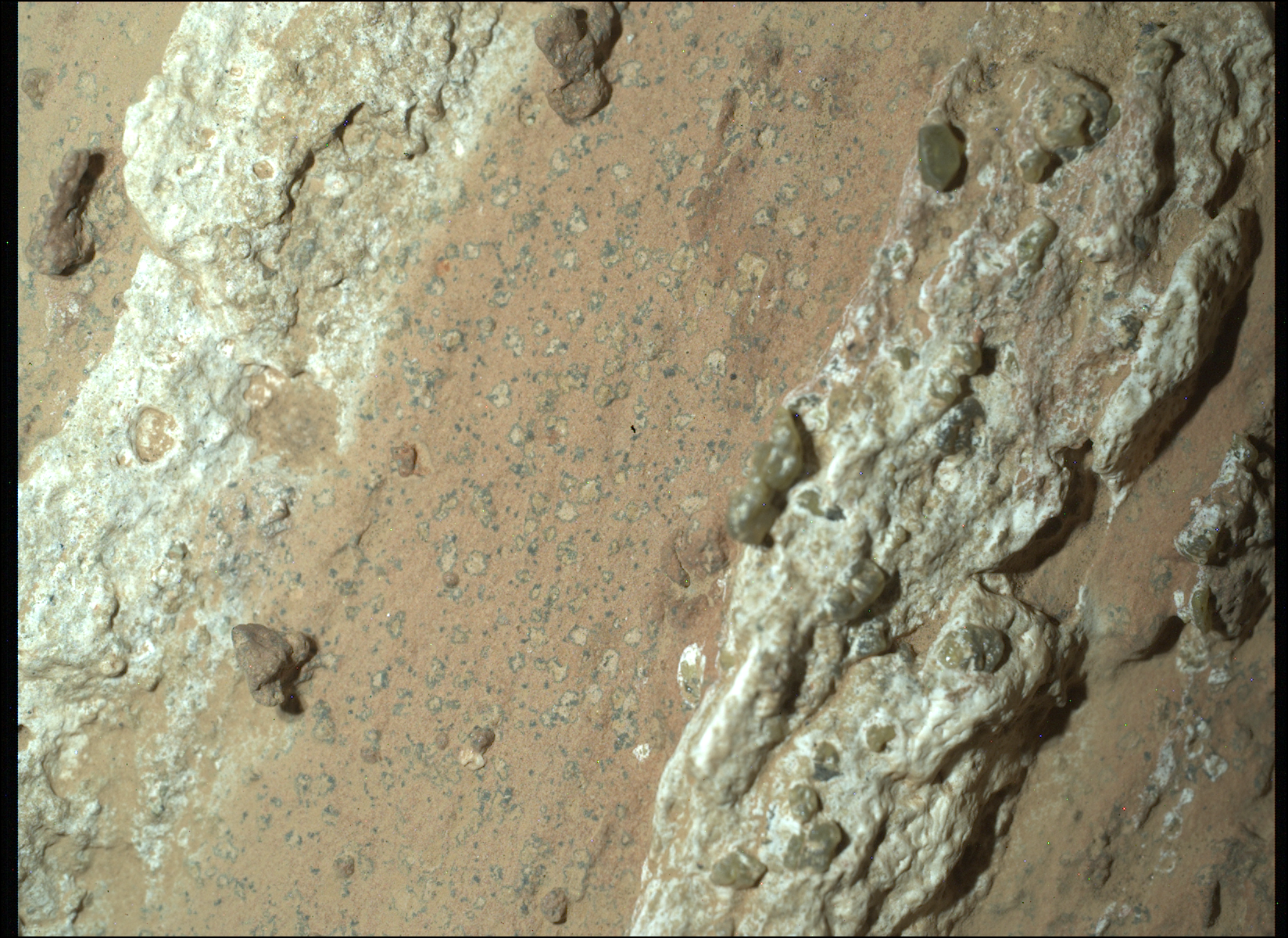
Perseverance found the arrowhead-shaped rock in Jezero Crater in July 2024. Its reddish surface was crossed by white mineral veins and crowded with pale, millimetre-scale patches ringed by dark material. The rover team called the markings leopard spots. Instruments later found organic carbon and patterns of iron, phosphorus and sulfur consistent with minerals that microbes commonly help produce in wet sediments on Earth.
A peer-reviewed analysis published in Nature in September 2025 made the Sapphire Canyon core drilled from Cheyava Falls the mission’s leading potential biosignature. NASA called it the best candidate Perseverance has encountered for preserving signs of ancient microbial processes.
But one part of the headline claim needs correcting: vivianite and greigite do not form only where microbes once lived. Both can be produced without biology. The case for Cheyava Falls rests on the minerals, textures, organic matter and geological setting appearing together, plus the difficulty of fitting several simple non-biological routes to the evidence. It is a serious candidate, not proof of life.
Edited by Lachlan Brown
Perseverance found the rock beside an ancient river channel
Cheyava Falls measures roughly one metre by 60 centimetres and lies in the Bright Angel formation along the northern side of Neretva Vallis. The 400-metre-wide valley once carried water into Jezero Crater, which held a lake billions of years ago. That setting matters because quiet water can lay down clay and silt capable of preserving chemical records long after a habitat disappears.
NASA’s first detailed report described a rock made of several conspicuous parts. Large white veins of calcium sulfate ran through it. Between them lay bands of rusty mudstone coloured by oxidised iron. Green olivine grains were embedded in some of the lighter material, and the rover’s SHERLOC instrument detected organic compounds in the rock.
The leopard spots occupied the red mudstone. Each irregular pale patch was bordered by a dark rim, with some larger features containing darker centers. NASA’s official close-up shows the spots at millimetre scale, scattered across the surface like tiny reaction zones rather than grains deposited with the original sediment.
Perseverance drilled Cheyava Falls on July 21, 2024, mission sol 1,215. The resulting 6.2-centimetre sedimentary core was sealed in a titanium tube and named Sapphire Canyon.
The rover mapped a reaction, not a microscopic fossil
Two instruments provided the central chemical evidence. PIXL, the Planetary Instrument for X-ray Lithochemistry, mapped elements using focused X-ray fluorescence. SHERLOC, the Scanning Habitable Environments with Raman and Luminescence for Organics and Chemicals instrument, mapped mineral bonds and fluorescence associated with organic material.
In the peer-reviewed Nature study, PIXL measurements showed iron and phosphorus in proportions consistent with vivianite, a hydrated ferrous iron phosphate. Iron and sulfur in the dark cores followed a ratio consistent with greigite, an iron sulfide. Zinc enrichment added another clue about how sulfur and iron had been reorganised.
Those identifications are strong compositional inferences, not the same as extracting a crystal and solving its structure in a laboratory. Rover instruments face limits on focus, resolution and mineral discrimination.
The spatial pattern is as important as the names. The inferred reduced minerals were associated with organic matter and with mudstone that had lost some of its oxidised red colour. Across several Bright Angel targets, more vivianite and greigite corresponded to less oxidised rock and a stronger organic signal. That relationship points to chemical reactions involving water after the mud accumulated.
On Earth, microbes can build this chemical sequence
Microbes do not need sunlight or oxygen to obtain energy. In waterlogged sediments on Earth, some consume organic matter while transferring electrons to oxidised iron. Others use sulfate. The reactions alter the surrounding minerals and leave reduced products behind.
Iron reduction dissolves ferric iron oxides and releases ferrous iron. In the presence of phosphate, that iron can precipitate as vivianite. Once usable oxidised iron is depleted, sulfate-reducing organisms can produce sulfide, which reacts with iron to form minerals including greigite. The result can be a bleached reaction zone with newly concentrated minerals around its boundary or core.
The spots resemble terrestrial reduction halos and reduction spots preserved in older rocks. Their pale interiors appear to record the transformation of rust-coloured iron, while their rims mark where elements concentrated again.
This proposed metabolism fits the ingredients in Bright Angel: organic carbon as an electron donor, oxidised iron and sulfate as electron acceptors, water for transport, and phosphate available to form a mineral product. Under the biological model, microbes would have turned that chemical gradient into energy and accidentally written their activity into the rock.
That is why NASA describes Sapphire Canyon as a potential biosignature. The phrase means that biology can explain the feature and that the feature is difficult enough to explain without biology to demand further tests. It does not mean life has been detected.
The minerals can form without life
The statement that these rings form on Earth only where microbes lived is not supported by the paper. The researchers explicitly tested a null hypothesis in which non-living chemistry created the reduced iron and sulfur phases.
Organic compounds can reduce iron oxides abiotically at temperatures between about 10 and 80 degrees Celsius. Mars can also acquire organic matter without life through atmospheric chemistry, reactions between water and rock, meteorites and interplanetary dust. Finding organic carbon beside an iron reaction is therefore suggestive but not diagnostic.
Other abiotic routes face specific obstacles. Oxidation of pre-existing pyrite could supply ferrous iron, but it would require pyrite and acidic fluids that the team did not find evidence for. Magmatic gases could deliver reduced sulfur, but no nearby hydrothermal or magmatic system was observed. Organic matter can reduce sulfate without enzymes, yet the reaction becomes extremely slow below roughly 150 to 200 degrees Celsius.
The Bright Angel mudstone shows no unambiguous sign of that degree of heating. Its fine texture was not visibly recrystallised by contact with hotter rocks, and the geological reconstruction would require deep burial to achieve such temperatures. This weakens a straightforward high-temperature explanation.
Weakening is not eliminating. The organic compounds are not known well enough to exclude low-temperature abiotic iron reduction. A distant sulfur source or unfamiliar Martian chemistry could also reproduce part of the pattern. The authors called for tests of both biological and abiotic pathways.
Why Cheyava Falls stands above earlier clues
Mars exploration has produced many habitability findings. Rovers have documented ancient lakes and rivers, clay minerals, organic molecules and energy sources that microbes could have used. A habitable environment, however, is not evidence that anything inhabited it.
Cheyava Falls combines several independent observations in one sedimentary rock. It formed in a water-related environment. It preserved organic material. It contains small reaction fronts with reduced iron and sulfur minerals. Their arrangement resembles features linked to microbial metabolisms on Earth, and the most obvious high-temperature non-biological explanation lacks supporting geological evidence.
The 2025 analysis therefore adds substantially to the initial Mars Daily report from 2024. At discovery, the spots were interesting textures with preliminary chemical clues. The later work mapped a coherent redox system across multiple Bright Angel rocks, compared possible mineral phases and evaluated specific null hypotheses.
Even so, Cheyava Falls contains no imaged cell, fossil body, biological polymer or isotope signature that only metabolism can plausibly generate. NASA has not announced ancient life on Mars. Calling the rock Perseverance’s strongest candidate describes its rank among available samples, not a final verdict.
The best evidence is sealed in a tube on Mars
NASA’s Mars sample catalogue identifies Sapphire Canyon as sample 25. It remains aboard Perseverance, protected inside a sealed tube. The rover can continue studying related outcrops, but it cannot perform the analyses needed to settle the origin of features only fractions of a millimetre across.
An Earth laboratory could map individual mineral grains at nanometre scales, determine exact crystal structures and measure isotopic ratios of carbon, sulfur and iron. It could identify specific organic molecules and test whether they are indigenous to Mars. Researchers could search for cell-scale organisation, repeating molecular preferences or isotope fractionation that strengthens a biological interpretation.
Scientists could also try to falsify the life hypothesis by exposing comparable minerals and organics to low-temperature water, radiation and volcanic gases. A non-biological process that reliably produces the same zoned spots would change the meaning of the rover observations.
Perseverance was designed to select and cache samples whose significance exceeds what a rover can decide alone. Cheyava Falls may be the clearest example of that design working. The spacecraft found the right geological context, mapped the right chemical relationships and drilled the right rock. The strongest candidate for ancient Martian life is now also a physical object that can, in principle, be tested.
Until that happens, the defensible description remains “potential biosignature.” Cheyava Falls is neither another spotted rock nor proof that Mars was inhabited. It is a question sealed inside Sapphire Canyon, waiting for instruments powerful enough to answer it.