
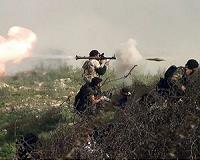
Syria vowed Saturday to retaliate following the deadly suicide assault in its third city Homs, as the UN said the attack was aimed to "spoil" sputtering peace talks starting in Geneva.
"The terrorist attacks that targeted Homs today were a clear message from the sponsors of terrorism to Geneva," said Bashar al-Jaafari, the Damascus envoy to the UN-brokered talks said.
"We want to tell them that this message has been received… and we won't allow for it to pass without retaliation," he told reporters at UN offices in the Swiss city.
Jaafari was speaking as he arrived for more talks with UN Syria envoy Staffan de Mistura.
The veteran diplomat was holding more separate meetings with Syrian regime and opposition negotiators, seeking to kickstart a new round of peace talks.
Speaking shortly before the Syrian envoy, de Mistura said the Homs attacks were designed to "spoil" peace talks.
Asked if the attacks would affect the UN-sponsored talks, he said: "I hope not, but it was tragic."
He added "every time we are having talks or negotiations there is always someone who tries to spoil. We were expecting that."
At the last such UN-sponsored talks the two sides did not meet for face-to-face negotiations, with de Mistura shuttling between them as a mediator.
The UN envoy said Friday that he would ideally like to get them to talk directly, but acknowledged that there were difficulties in achieving that.
The suicide assaults on two security service bases in Syria's third city of Homs killed dozens of people, including a top intelligence chief, overshadowing the Geneva talks.
Syria's former Al-Qaeda affiliate Fateh al-Sham Front claimed the spectacular attack which targeted and killed General Hassan Daabul, a close confidant of President Bashar al-Assad.
The Syrian Observatory for Human Rights said 42 people were killed when the bombers targeted the headquarters of state security and military intelligence in the heavily guarded Ghouta and Mahatta neighbourhoods.
Provincial governor Talal Barazi said 30 people were killed and 24 wounded.
In name at least, ISIL is defeated
Washington (AFP) Feb 24, 2017 –
ISIL is no more.
At least, that's the case in the hallways of the Pentagon, where military officials have done an about-face and started calling the Islamic State group ISIS, not ISIL.
The latter acronym, standing for Islamic State in Iraq and the Levant, was for years insisted on by Barack Obama's administration, even though few people outside of Washington seemed to use it.
ISIS stands for Islamic State in Iraq and Syria, and is more commonly used in daily conversation, as well as by President Donald Trump.
"We have made a decision to follow what our chain of command says and… (that) is what the American people understand," Pentagon spokesman Jeff Davis said Friday.
"ISIS is the term that Joe Q. Public understands what it means and is what they use, so we are using that term."
The Pentagon issued a memo on February 13 officially directing staff to use ISIS.
When IS emerged in 2014, news organizations and international governments were divided over what to call it.
Most outlets went with the "Islamic State group" or "so-called Islamic State," often abbreviating the name to IS on second reference.
In the Middle East, the Arabic acronym "Daesh" stuck, and that was a term taken up by French President Francois Hollande and former British premier David Cameron.
A British government Twitter account that had been called "UK Against ISIL" was changed to "UK Against Daesh" as Cameron made the announcement.
"#Daesh is Arabic acronym for #ISIL. Daesh hates the term + sounds similar to Arabic words Daes & Dahes: 'to trample' & 'one who sows discord,'" read a tweet on the account.
