
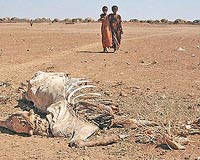
Children are going to bed hungry in DR Congo's second city, their parents say, as food shortages caused by a severe drought in southern Africa drive up prices.
For Lubumbashi's two million plus people, who depend for almost all their staples on imports from nearby Zambia, the talk is all about the soaring price of maize flour — and the shortage of this basic food.
"It has been more than a month since Zambia refused to deliver export permits for their flour," Coundouris Psaromatis, a Greek businessman who runs a chain of shops and supermarkets in Lubumbashi, told AFP.
"In all of my shops, I have no more bags of maize flour to sell: it's all gone."
^This week a delegation of four key ministers travelled from the capital Kinshasa to the southeastern copper and cobalt mining hub to address the growing crisis. A day later President Joseph Kabila came too.
Jeanne Kayakez, a maize flour seller at the main Mzee-Kabila market who has 11 children, says even she is struggling.
"Even I am unable to feed my children at the moment. For two weeks we've been eating cassava roots and sometimes rice. It's really sad," she said.
– 'Stop lying to us' –
Times are tough, said Eudoxie Gungwa, who sells clothes at the market.
"People aren't buying my clothes and maize flour is rare and expensive. What'll happen to us? The authorities should stop lying to us with false promises," she said.
Lubumbashi has suffered particularly badly following a move by Zambian authorities to limit the export of corn and corn products, such as maize flour — a key ingredient in local cooking.
Zambia, along with Malawi, Zimbabwe and Lesotho, is suffering food supply problems, while South Africa has said the recent drought was its worst in more than 100 years.
Faced by food shortages Zambian officials banned the export of corn and corn products on April 5.
Though the restriction was lifted a week later, the volume of corn products crossing into DR Congo has yet to recover to pre-ban levels, causing shortages in the country's south east.
Lubumbashi, which is just 50 kilometres (30 miles) from the Zambian border, has been hit hardest.
Last Saturday, a 25 kilo (55 pound) bag of maize flour was selling for 20,000 Congolese francs ($21.50 at the unofficial, local exchange rate) compared to just $10 in January.
Earlier that week the price reached a peak of $30 per bag.
– 'Dishonest traders' –
The World Food Programme (WFP) said it is following the situation closely.
In an interview with AFP, Agriculture Minister Emile Mota accused "dishonest traders" of causing the shortages by taking advantage of the period before the harvest.
The ministerial taskforce said it had taken a series of measures to "flood the markets of Lubumbashi" with maize flour, including exempting corn and corn products from import duties.
But one agricultural expert, who asked to remain anonymous, blamed the "weakness of the local offering", pointing to the area's high population growth and heavy dependence on copper and cobalt mining.
The expert said the season in the Lubumbashi area had been good but warned that the food produced during the harvest from May to June would not be enough to end the crisis.
