
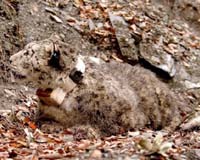
Conservationists have fitted a snow leopard in northwest Pakistan with a satellite-tracking collar to uncover the secrets of one of the world's most endangered and elusive animals. In a scientific first, international experts hid among icy peaks for weeks to trap the 35 kilo (77 pound) female and attach the high-tech GPS (global positioning system) device.
Since the feline was released back into the wild earlier this month the collar has fed back unprecedented data on its movements and habitat, with plans underway to tag five leopards altogether.
"This is the first time in history that a snow leopard has been fitted with a GPS collar," Javed Khan, Pakistan programme director of the Seattle-based Snow Leopard Trust, told AFP.
Snow leopards are found in the remote mountains of Central Asia, spanning 12 countries from Afghanistan to China.
But the species is close to extinction with only 5,000 to 7,000 left in the world — around 350 in Pakistan. Populations are in decline due to poaching, revenge-killing by herders and decline in their natural prey.
And helping them has been difficult because until now their solitary nature has made them almost impossible to study.
The snow leopard that has been satellite-tagged was captured on Purdum Mali ridge in Pakistan — Purdum Mali means cave of the snow leopard in the local dialect, Chitrali.
"It was a fitting place," said Tom McCarthy, conservation director of the Snow Leopard Trust, which is jointly running the scheme with the North West Frontier Province Wildlife Department and the World Wildlife Fund.
The team installed 15 "non-invasive" snares fitted with radio transmitters at isolated locations to capture the animal.
They named the cat Bayad-e-Kohsaar ("In Memory of Mountains" in the Urdu language) to honour several conservationists who died in a helicopter accident in Nepal in September.
The snow leopard was then fitted with the collar on November 17 at the Chitral Gol National Park and released.
Data from the collar is uploaded several times a day via satellite and sent to the conservationists' emails. It has already revealed substantial detail about the cat's movements, the trust said.
The collar will automatically drop off after 13 months.
The team now aims to capture another four snow leopards and tag them.
McCarthy and other conservationists will periodically live in a camp in the remote Chitral valley until late January to monitor the snaring of the cats, which live at an altitude of around 3,000 metres (9,900 feet).
Once the leopards are caught, their age, weight and sex are recorded and the tracking system is fitted before they are released back into the wild.
The GPS programme is one of a number of schemes to save the snow leopard, which is listed as endangered on the World Conservation Union Red List of Threatened Species, the same classification as the panda and the tiger.
Many of the programmes involve local communities in protecting the cats and their habitat. In August an orphaned snow leopard cub found by a goat herder in northern Pakistan was temporarily transferred to New York's Bronx Zoo.
But the Snow Leopard Trust and other groups say they also work with local people to deal with their concerns about the cats, which can kill livestock and sometimes humans.
In August 2005 police in northwestern Pakistan shot dead a snow leopard that had reportedly killed six women.
Source: Agence France-Presse
