
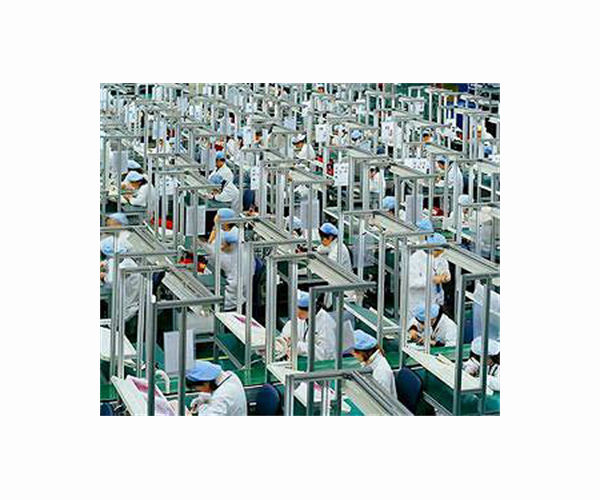
China's factory and services activity picked up in June, official data showed Thursday, fuelled by the easing of Covid-19 restrictions in major cities such as Shanghai and Beijing.
The non-manufacturing Purchasing Managers' Index (PMI), a key gauge of activity in the world's second-biggest economy, defied expectations and surged to 54.7 points in June after three months of sluggish performance.
It was the first time since February that the reading was above the 50-point mark separating growth from contraction. It sat at 47.8 in May.
"As the situation of domestic epidemic prevention and control continued to improve and a package of policies… to stabilise the economy was implemented at a quicker pace, the overall recovery of our country's economy has accelerated," National Bureau of Statistics (NBS) senior statistician Zhao Qinghe said in a statement.
In particular, business activity in industries severely hit by the pandemic such as rail and air transport picked up in June, the statement said.
Construction activity also helped fuel the PMI boost.
But the "surprisingly rapid recovery in services" likely reflects a one-off boost from reopening, said Julian Evans-Pritchard, senior China economist at Capital Economics.
Manufacturing PMI rose to 50.2 points in June — similar to analyst expectations — up from 49.6 in May.
As work resumed after Covid lockdowns, production and demand in the sector picked up and delivery times improved, according to the NBS.
China is the only major economy still pursuing a zero-Covid approach of eliminating outbreaks as they emerge, using snap lockdowns and mass testing.
While the country is shortening quarantine times for new international arrivals, President Xi Jinping warned this week that China "would have faced unimaginable consequences" had it adopted a herd immunity or hands-off approach, signalling the government would persist with its current policy.
The approach has taken a harsh toll on the economy, with shops and factories forced to stop operations and supply chains strained.
The non-manufacturing rebound in June was "mainly due to more construction activity", said Iris Pang, chief economist for Greater China at ING.
"We think that it will be challenging for the government to achieve the 5.5 percent GDP target set in March. There will need to be a lot more infrastructure activity if the government is to achieve this target."
Asian markets mostly down but China data offers some light
Hong Kong (AFP) June 30, 2022 –
Most Asian markets fell again Thursday as traders fear that hefty rate hikes to rein in soaring inflation will spark a recession, though a slight improvement in Chinese data did provide some cheer.
The rally enjoyed across the world last week appears to have given way to nervousness about the economic outlook, while the Ukraine war continues to sow uncertainty.
The surge in inflation to multi-decade highs has forced central banks to swiftly tighten pandemic-era monetary policies, dealing a hefty blow to equities, particularly tech firms who are susceptible to higher borrowing costs.
The Federal Reserve has already sharply lifted rates and is expected to announce a second successive 75-basis-point lift next month.
There had been hope that policymakers would ease off their hikes as economies show signs of slowing, but analysts say some officials are less concerned about a recession than letting prices run out of control.
Fed boss Jerome Powell this month admitted the moves could lead to a contraction, suggesting he was not averse to it.
On Wednesday, Cleveland Fed chief Loretta Mester said was keen to see the benchmark rate hit 3-3.5 percent this year and "a little bit above four percent next year".
"There are risks of recession," she told CNBC. "We're tightening monetary policy. My baseline forecast is for growth to be slower this year."
The threat of an extended period of elevated inflation and rate hikes has left traders weary, and markets in the red.
While Wall Street ended on a tepid note Wednesday it was unable to bounce back from the previous day's plunge.
And Asia also struggled, with Tokyo, Sydney, Seoul, Singapore, Taipei, Manila and Wellington all down.
– China support hope –
However, Hong Kong and Shanghai edged up. That came after official figures showed a forecast-beating improvement in China's services sector thanks to the easing of painful Covid-19 restrictions in major cities including Shanghai and Beijing.
The non-manufacturing Purchasing Managers' Index surged to 54.7 points in June, the first time it has been above the 50-point growth mark since February.
The manufacturing gauge hit 50.2, which was also its first time in growth since February and provided some hope that the world's number two economy could be picking up after the pain caused by lockdowns.
"As the situation of domestic epidemic prevention and control continued to improve and a package of policies… to stabilise the economy was implemented at a quicker pace, the overall recovery of our country's economy has accelerated," National Bureau of Statistics statistician Zhao Qinghe said.
And SPI Asset Management strategist Stephen Innes added that the government and People's Bank of China could now have some room to provide growth support.
"With (consumer price) inflation low in China relative to its peers, there is plenty of scope for monetary and fiscal conditions to loosen in the second half of the year, supporting activity," he said in a note.
Crude fluctuated after dropping on Wednesday as data showed demand in the United States appeared to be softening even as the driving season gets under way, and as recession fears begin to kick in.
"The higher price environment appears to be doing its job when it comes to demand," Warren Patterson, of ING Groep NV, said.
The drop comes as OPEC and other major producers including Russia prepare to meet on their output agreement, with most predicting they are unlikely to open the taps further.
"I am not expecting any surprises from the group. I would imagine it will be a fairly quick meeting," Patterson said.
– Key figures at around 0300 GMT –
Tokyo – Nikkei 225: DOWN 0.9 percent at 26,561.05 (break)
Hong Kong – Hang Seng Index: UP 0.3 percent at 22,048.60
Shanghai – Composite: UP 0.8 percent at 3,387.96
West Texas Intermediate: UP 0.2 percent at $109.95 per barrel
Brent North Sea crude: DOWN 0.4 percent at $115.77 per barrel
Dollar/yen: DOWN at 136.56 yen from 136.66 yen Wednesday
Euro/dollar: UP at $1.0456 from $1.0444
Pound/dollar: UP at $1.2139 from $1.2119
Euro/pound: DOWN at 86.13 pence from 86.15 pence
New York – Dow: UP 0.3 percent at 31,029.31 (close)
London – FTSE 100: DOWN 0.2 percent at 7,312.32 (close)
