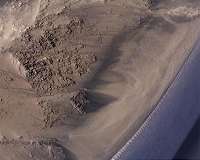
Recurring slope lineae (RSL) are seasonal flows on warm slopes, and are especially common in central and eastern Valles Marineris, as seen in this observation by NASA's Mars Reconnaissance Orbiter (MRO). This image covers a large area full of interesting features, but the enhanced color closeup highlight some of the RSL.
Here, the RSL are active on east-facing slopes, extending from bouldery terrain and terminating on fans. Perhaps the fans themselves built up over time from the seasonal flows. Part of the fans with abundant RSL are dark, while the downhill portion of the fans are bright. The role of water in RSL activity is a matter of active debate.
The map is projected here at a scale of 50 centimeters (19.7 inches) per pixel. [The original image scale is 52.6 centimeters (20.7 inches) per pixel (with 2 x 2 binning); objects on the order of 158 centimeters (62.2 inches) across are resolved.] North is up.
The University of Arizona, Tucson, operates HiRISE, which was built by Ball Aerospace and Technologies Corp., Boulder, Colo. NASA's Jet Propulsion Laboratory, a division of Caltech in Pasadena, California, manages the Mars Reconnaissance Orbiter Project for NASA's Science Mission Directorate, Washington.
Image credit: NASA/JPL-Caltech/Univ. of Arizona
Prolific Mars Orbiter Completes 50,000 Orbits
The most data-productive spacecraft yet at Mars swept past its 50,000th orbit this week, continuing to compile the most sharp-eyed global coverage ever accomplished by a camera at the Red Planet.
In addition, the spacecraft – NASA's Mars Reconnaissance Orbiter (MRO) – recently aided preparations for NASA's next mission to Mars, the InSight lander. Insight will launch next year on a mission … read more