
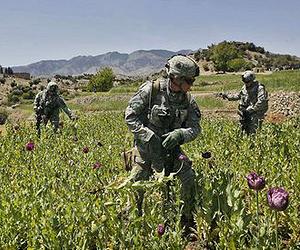
Moscow's top anti-drug cop slammed Washington on Saturday over US policies on opium production in Afghanistan, news agencies reported, amid concern over a deadly wave of heroin use in Russia.
"US statements on its refusal to eradicate opium plantations… sound like a solid guarantee of impunity for drug producers," Viktor Ivanov, head of Russia's Federal Narcotics Control Service, was quoted as saying.
After taking office last year, US President Barack Obama made a major policy shift by ending a military drive to destroy poppies, believing it alienated Afghanistan's poorest who only grew the crop to make money.
But the shift upset Moscow, which says some 30,000 Russians died in 2009 because of their consumption of Afghan heroin.
Ivanov also blasted NATO for targeting poppy growers linked to the Taliban insurgency, deriding their production as a tiny fraction of the total opium produced in Afghanistan.
"NATO commanders have focussed their efforts solely on battling these producers, who are in the minority, while generously leaving the task of fighting the other 99 percent to Afghan regional authorities," he said.
War-ravaged Afghanistan is the world's largest producer of heroin. In 2009 the potential gross export value of opium from the country was 2.8 billion dollars, according to the UN drugs agency.
Much of that heroin is smuggled through Central Asia into Russia and on to Europe, contributing to Russia's drug epidemic. Some 90 percent of heroin consumed in Russia had Afghan origins, Ivanov said.
Ivanov also claimed that Russia's arch-foe Georgia was a key smuggling route for Afghan heroin, calling the Georgian ports of Batumi and Poti and the city of Kobuleti major drug-trafficking centres.
earlier related report
Afghans begin taking over US-led prison
Kabul (AFP) Feb 27, 2010 –
Afghanistan began Saturday taking control of a notorious US-run prison at Bagram Air Field north of Kabul, in a process officials said they expected would take up to one year.
The prison, which houses suspected Taliban-linked militants captured by US and NATO troops, has been criticised by Afghan and international rights groups.
Many of the detainees have never been charged with any offence.
In January, Afghan authorities and US forces operating in the war-ravaged country signed an agreement to transfer control of the jail to Afghanistan.
"This is the start of the process," Mohammad Qaseem Hashimzai, deputy justice minister, told reporters.
"As a first step we will soon send a team of judicial officials (and) in three months the Afghan national army will take control of the prison facility," he said.
"By January 2011 we'll be in full control of the prison."
The transfer will include a recently opened prison, called the Detention Facility in Parwan, after the region in which it is situated, that can hold more than 1,000 inmates and replaces the old 650-detainee facility at Bagram.
Hashimzai described the new, 61-million-dollar facility as "a model prison".
The US military would train about 300 Afghan soldiers as wardens before they take charge, he said.
In turn, the army will transfer control to the ministry of justice, which oversees Afghanistan's prisons, in two years, deputy defence minister General Mohammad Akram said.
A primary court and a team of prosecutors will be stationed at the facility — attached to Bagram, the biggest US military base in Afghanistan — to review detainees' files, Hashimzai said.
More than 800 Afghans and up to three dozen "foreign" militants are held at the facility, US military officials in Afghanistan have said.
Human rights campaigners have criticised the new facility, saying that it fails to comply with international norms as some inmates are victims of arbitrary detention, have no recourse to legal representation or knowledge of the charges against them.
Bagram prison gained a reputation for extra-judicial brutality in December 2002, when two inmates died within a week of each other.
They were officially said to have died of natural causes but an inquiry later revealed they had been beaten, chained and deprived of sleep.
Share This Article With Planet Earth
