
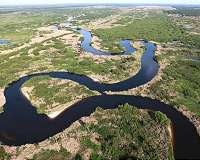
Researchers have finally found the location of Fort San Antón de Carlos. Archaeologists traced the Spanish fort to Florida's Mound Key, home of the Calusa, one of the region's most powerful Native American tribes.
Since 2013, archaeologists have been searching for physical evidence of the fort among the coastal islands of southwestern Florida. Built in 1566, the fort was home to one the first Jesuit missions in North America. Conflicts with the Calusa forced the Spaniards to abandon the fort only a few years after its construction.
"Before our work, the only information we had was from Spanish documents, which suggested that the Calusa capital was on Mound Key and that Fort San Antón de Carlos was there, too," William Marquardt, curator emeritus of South Florida archaeology and ethnography at the Florida Museum of Natural History, said in a news release. "Archaeologists and historians had visited the site and collected pottery from the surface, but until we found physical evidence of the Calusa king's house and the fort, we could not be absolutely certain."
Archaeologists at the University of Florida and the University of Georgia used a combination of remote sensing, ground-penetrating radar and excavations to identify the walls of the ancient fort. Targeted digs turned up a variety of artifacts, including ceramic shards and beads.
Researchers detailed their discovery of the fort in a paper published this week in the journal Historical Archaeology.
The fort's foundation and walls were formed by a concrete made of shells. The concrete mixture features lime, which is made from burning seashells. The lime is mixed with sand, ash, water and larger shell fragments.
"Seeing the straight walls of the fort emerge, just inches below the surface, was quite exciting to us," Marquardt said. "Not only was this a confirmation of the location of the fort, but it shows the promise of Mound Key to shed light on a time in Florida's — and America's — history that is very poorly known."
Prior to the arrival of Europeans, the Calusa had developed a sophisticated society of fisher-gatherer-hunters. The Native Americans made tools, utensils and jewelry from shells, and constructed elaborate fenced corals in which to trap and hold fish prior to eating.
While the Calusa avoided colonization for more than 200 years, the complex confederation of fisher-hunter-gatherers couldn't escape the diseases brought by European colonists. By the time Britain assumed control of Florida, what was left of the Calusa tribe had left for Cuba.
"Despite being the most powerful society in South Florida, the Calusa were inexorably drawn into the broader world economic system by the Spaniards," Marquardt said. "However, by staying true to their values and way of life, the Calusa showed a resiliency unmatched by most other Native societies in the Southeastern United States."
Scientists hope continued excavations on Mound Key will offer up new insights into the ways early Spanish colonizers and member of the Calusa might have interacted.
"Seeing the straight walls of the fort emerge, just inches below the surface, was quite exciting to us," Marquardt said. "Not only was this a confirmation of the location of the fort, but it shows the promise of Mound Key to shed light on a time in Florida's — and America's — history that is very poorly known."
