
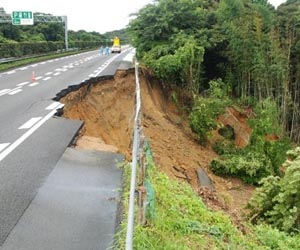
Japan's Okinawa island was hit by its biggest seismic jolt in more than half a century on Saturday when a powerful earthquake struck, triggering minor tsunamis.
The 7.0 magnitude tremor was measured at a depth of 22 kilometres (14 miles) and was centred 81 kilometres east-southeast of Naha in Okinawa, the US Geological Survey said.
Japan's Meteorological Agency issued a tsunami warning off Okinawa island, which was later lifted. The agency separately warned against possible landslides on the island, where rain was forecast later in the day.
Small waves of around 10 centimetres (four inches) were recorded in southern areas of Okinawa, the agency said, adding that additional minor surges of the sea level may still be seen near the island.
It was the biggest jolt in Okinawa since at least the war, an agency official said, adding that the island is believed to be located in a geologically stable region.
"It could even trace back to 1911 when a major earthquake with an estimated magnitude of 8.0 hit the island," the agency official said.
Two people aged 66 and 74 were injured as they fell following the earthquake, but neither was seriously hurt, local officials said.
Water pipelines were ruptured at about 50 locations, while at least seven houses were damaged with trees and stonewalls falling over in the subtropical island, home to US military bases.
"The earthquake woke me up with fear this morning," Yasushi Ohama, an Okinawa prefectural government official, told AFP on the phone.
"It was the biggest one I have ever experienced, but fortunately we have not received serious damage or casualties despite the size of the quake," Ohama said. "People did not panic. Business is going on as usual here."
In Tokyo, the government set up a liaison office at the prime minister's office to gather information on the quake, officials said.
The USGS had initially reported the quake at 7.3 magnitude.
Around 20 percent of the world's most powerful earthquakes strike Japan, which lies near the junction of two tectonic plates.
Geologists warn that Japan is overdue for a massive and potentially devastating earthquake.
They warn there is an 87 percent chance that the "Big One" — of at least magnitude-eight — will strike the greater Tokyo region, home to around 35 million people, within the next 30 years.
The last time a great quake struck the city was in 1923, when the Great Kanto Earthquake claimed more than 140,000 lives, many of them in fires.
The earthquake devastated the Haitian capital of Port-au-Prince last month was also magnitude 7.0.
More than 200,000 people were killed in that disaster, which also left some 1.2 million people homeless.
Share This Article With Planet Earth
