
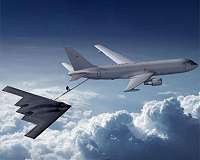
More bad news for US aviation giant Boeing: the US Air Force said Tuesday it had halted for a second time the acceptance of new KC-46 tankers due to ongoing quality issues.
Air Force Secretary Heather Wilson revealed the March 23 decision — another setback in the already delayed air tanker program — during a budget hearing in Congress.
"The Air Force again halted acceptance of new KC-46 tanker aircraft as we continue to work with Boeing to ensure that every aircraft delivered meets the highest quality and safety standards," Wilson told the panel.
She said that Air Force inspectors had discovered "foreign object debris" in the new planes that should not have been there as well as other areas "where Boeing did not meet quality standards."
The problems were "unrelated to design or engineering specifications," she noted.
But it was the second time this year Boeing faced the same criticism.
The Air Force took its first KC-46 in January, more than one year late.
Currently they have seven KC-46 aircraft in service.
The Air Force plans to buy 179 KC-46s over the course of the program.
Based on the airframe of the Boeing 767, the aerial refueller is to replace the Air Force's aging line of KC-10 and KC-135 tankers, many of which were manufactured during the Cold War.
The Air Force chose Boeing to build the tanker over Airbus in 2011 after a furious battle between the two companies over the massive contract.
FlightSafety Services awarded $29.5M for KC-46 training
Washington (UPI) Mar 29, 2019 –
FlightSafety Services has been awarded a contract not to exceed $29.5 million for KC-46 Aircrew Training System production in a fourth-year option as delivery of Boeing's new refuelers resumed earlier this month after grounding.
The contract involves equipment for McGuire Air Force Base in New Jersey and Altus AFB in Oklahoma, the Air Force announced Thursday.
In the modified contract, it will include an additional weapon system trainer, boom operator trainer, fuselage trainer, pilot part task trainer, boom operator part task trainer, additional learning management workstations, support equipment for the KC-46 Pegasus.
Work on the contract will be performed in Broken Arrow, Okla., and is expected to be complete by February 2021.
Fiscal 2018 purchasing and procurement funds in the amount of $14.4 million are being obligated at the time of award.
A new Pegasus flew to Altus on March 11 for the first time since a one-week grounding because loose tools and other items were found inside completed airplanes. The Air Force resumed receiving KC-46 tankers because it passed an object debris inspection at Boeing's production facility.
It was the third KC-46 tanker, a reconfigured 767, delivered to the base, which the Air Force considers as the premier training location for the plane.
Altus' 97th Air Mobility Wing welcomed its first KC-46A Pegasus on Feb. 8. And on March 25, Altus' 56th Air Refueling Squadron conducted the first air refueling from a KC-46 Pegasus to a C-17 Globemaster III for the 97th Air Mobility Wing over Texas.
The base is projected to receive several more KC-46 aircraft as training continues.
The first of 14 maintenance hangars are nearing completion at Oklahoma City's Tinker Air Force Base. Flight crews will be trained at Altus and the KC-46s will eventually fly into Tinker for maintenance. The work will lead to the creation of an estimated 1,300 jobs, according to the Greater Oklahoma City Chamber of Commerce.
Last week, the maintainers of the 22nd Aircraft Maintenance Squadron at McConnell Air Force Base in Kansas performed the first KC-46 A-Check. This check will take between 240 and 320 work hours based on initial training.
In January, the Air Force accepted the first tanker from Boeing in January.
Later that month, the first KC-46 flew to McConnell from Boeing's production plant in Washington state following scheduling and cost overruns dating to when the company was awarded the contract eight years ago.
Boeing plans to deliver 36 of the aircraft this year and about a dozen more are nearing completion, said Mike Gibbons, Boeing vice president.
The KC-46 is built as an empty 767 airframe in Everett, Wash., then transferred to the south end of Paine Field, called the Military Delivery Center. The jet's military systems, including the refueling and communications equipment, are installed there.
The KC-46 Pegasus is a wide body, multi-role tanker that will be able to refuel all U.S., allied and coalition military aircraft compatible with international aerial refueling procedures. The KC-46 is capable of carrying a fuel capacity of 212,000 pounds.
#Maintainers of the 22nd Aircraft Maintenance Squadron at @22ARW worked together to perform the first KC-46 A-Check last week. This check will take between 240 to 320 work hours based on initial training. #TeamWorkMakesTheDreamWork #TankerThirstThursday #Maintenance #NKAWTG pic.twitter.com/K9djxBSkS6- Air Mobility Command (@AirMobilityCmd) March 28, 2019
