
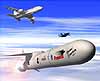
The Terriers satellite, part of NASA's Student Explorer Demonstration Initiative, is scheduled for launch aboard an Orbital Sciences Pegasus XL rocket on Monday, May 17 (PDT).
The drop of the Pegasus from an L-1011 aircraft will occur at a location over the Pacific Ocean 150 miles northwest from the coast of Vandenberg Air Force Base, CA. The launch window extends from 10:05:47 – 10:14:26 p.m. PDT. The drop of the Pegasus from the L-1011 aircraft is targeted to occur at 10:10 p.m. PDT.
Terriers stands for Radio Sources. The spacecraft has been developed by Boston University with a funding grant from NASA.
Terriers is designed to study the ionosphere. This highly ionized area, beginning at an altitude of about 30 miles and extending to about 250 miles, is one of the least understood parts of Earth's atmosphere. Understanding this area is becoming increasingly crucial as it is becoming home to many scientific spacecraft and commercial communications satellites. Radio signals including AM, FM, and short wave radio signals reflect off this region. The Space Shuttle, International Space Station and other scientific spacecraft orbit in this area.
Launch Coverage
The prelaunch news conference will be held at 12 noon PDT on Sunday, May 16 and carried on the "V" audio circuits which may be dialed at Area Code (407) 867-1220, 867-1240, 867-1260, 867- 4003, 867-7135, and 867- 4920. The prelaunch news conference will not be carried on NASA Television.
Launch coverage will carried on the V circuits (audio monitoring only) beginning with departure of the L-1011 aircraft at 9 p.m. PDT, and will conclude after the Terriers spacecraft separates from the Pegasus approximately 10 minutes after launch.
The launch will not be carried on NASA Television.
