
Late in the 20th century, more than a dozen countries came together to collaborate on one of humanity's engineering marvels: the International Space Station. While the citizens of Earth have benefited from the 15 years of science conducted on the orbiting laboratory, much of the success of the more than 1,700 investigations performed so far are the result of research partnerships between private companies and space agencies around the world.
Several of these scientific advances are profiled in the new ISS Benefits for Humanity 2015 book highlighting the collaborations that help people on Earth live healthier and more productive lives.
"As a National Laboratory, the ISS works with private industry to drive advances in research to improve our lives, from pioneering new technology to studying how microgravity impacts the physiological systems of our bodies," said Dr. Kirt Costello, space station deputy chief scientist.
"Together we are using this unique laboratory to search for answers wherever they may be – looking outwards using our unique vantage point on the Earth and inward toward the building blocks of life under microscopes. The discoveries enabled by this research enrich our lives by leading to new product development, helping to commercialize low-Earth orbit and increasing our knowledge in the ongoing fight to combat disease."
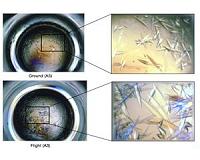
One such company is carrying on a long tradition of examining protein crystals in microgravity to help develop new drugs to help physicians fight disease. Merck Research Laboratories, headquartered in Keniworth, New Jersey, has studied protein crystals in microgravity, first during space shuttle missions and later on the space station.
Merck's protein crystals are engineered antibodies that can bind themselves to the substances that cause disease, delivering medicines directly to the area needing treatment. These crystals are fragile and subject to disruption by gravity, so some of them are difficult to study on Earth.
On the space station, the absence of gravity and convection allows for the growth of larger and more perfectly formed crystals, helping researchers examine the structure of the proteins more easily and design new pharmacological treatments to fight a particular disease.
Merck is working closely with the Center for the Advancement of Science in Space (CASIS), the nonprofit organization that manages the U.S. National Laboratory, to continue research on the proteins called monoclonal antibodies (MAB). Highly concentrated suspensions of the crystallized MABs created on the space station may help Merck develop a drug with higher concentrations of the antibodies needed to fight disease.
Two companies have sent rodents to the space station to investigate the muscle and bone loss suffered by astronauts during long-duration missions. Data from the research conducted by both Amgen in Thousand Oaks, California, and the Novartis Institutes for BioMedical Research in Cambridge, Massachusetts, could help millions on Earth suffering from muscle atrophy and bone loss.
In microgravity, muscles can atrophy and bones lose mass due to lack of normal weight-bearing activities. People suffering from osteoporosis, injuries or illness on Earth can suffer the same effects. While crew members in space use nutrition and specific exercises to help mitigate the problem, the illness or impairment suffered by those on Earth may restrict these countermeasures. Researchers have studied rodents flown on the space station to try to better understand the phenomenon.
During the last 14 years, Amgen investigated three different drugs that targeted these problems; two focused on bone loss and one on muscle atrophy. All three showed significant promise toward addressing the problem, and Amgen is planning longer test runs to increase data collection.
The Novartis team took a different path in 2014, studying rodents that were genetically engineered to resist muscle loss, removing the gene that creates the protein that labels certain other muscle proteins for degradation. An increase in this protein had been measured in previous flights. Researchers are still analyzing data but expect that the engineered rodents flown in space will have experienced less atrophy than the controls on Earth.
Proctor and Gamble of Cincinnati, a long-time creator of consumer goods found in many homes, is working with the space station program to help create products that are easy to use and have a long shelf life. The company's concern is with colloids, studying how solids, gas and liquid phases separate, which is much easier to see and understand in microgravity.
It wants to create liquids that are better able to suspend particles or a different liquid such as liquid detergents, fabric softeners, or medicines, perhaps leading to improving health, beauty and household products used every day. Gaining a better understanding of these physical properties could even help in the creation of liquid pharmaceuticals.
The unique environment on the International Space Station provides opportunities for many types of commercially viable research. The diverse interests of the corporate world have a place in space, impacting the lives of people living and working on, and off, Earth.
