
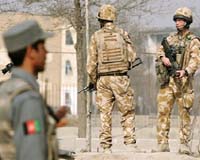
The NATO commander in southern Afghanistan called Sunday for most of the extra US troops due next year to be sent to his area, which he called the main military effort against extremists.
After a difficult 2008, the United States is expected to send 30,000 additional troops to Afghanistan by next summer to add to the almost 70,000 international soldiers already here under NATO and US command.
Dutch Major General Mart de Kruif told reporters it was not yet clear how many of these reinforcements would be deployed in Regional Command (RC) South which includes Kandahar and Helmand provinces that see heavy fighting.
"I can only tell you and it makes sense to send the most forces where the military main effort is and there is no doubt in my mind that the military main effort is in Helmand … in Kandahar," he said.
"It will surprise me if the bulk of the force wouldn't go to RC South because the military main effort towards all Afghanistan is in RC South," he said.
The US military has already indicated that most of the soldiers would be sent to the east, where there is also heavy insurgent activity, and to central areas near the capital, Kabul.
Southern Afghanistan is the heartland of the Taliban who lead the insurgency. The hardliners were driven from government in a US-led invasion in 2001 when they refused to hand over their Al-Qaeda allies.
NATO's International Security Assistance Force has just over 18,100 troops in the south, most of them British, Canadian and Dutch. ISAF has more than 51,000 soldiers in the whole country.
De Kruif, who took command of RC South in November, said the rebels had stepped up their use of improvised explosive devices (IEDs) over the past year.
"I would not agree to the statement that the security situation has got worse. I would say that it has been different.
"It is very obvious that the insurgents were forced to change their tactics from large scale attacks to the use of IEDs in attacking and terrorising local people," he said.
The general said he was optimistic that more foreign troops in 2009 and the growing capacity of the Afghan National Army would mean more military success.
However it was not sufficient for soldiers to clear areas of militants without follow-up development by the government and its allies.
"You have to set all the conditions in place to create conditions for security and governance and reconstruction and development," he said.
"If you are not prepared to do so, it just doesn't make sense. So it is not just about pouring in more troops."
Share This Article With Planet Earth
