
The Columbia tragedy in February 2003 forced a deeply wounded NASA to reform, but the space agency hopes for a triumphant return to flight next week with the Discovery shuttle's launch amid ambitious plans for missions to the Moon and Mars.
An investigation on the Columbia accident took aim at NASA culture, criticizing officials' obsession with respecting flight schedules to finish work on the International Space Station, to the detriment of astronaut safety. Seven crew members died in the crash over Texas.
The disaster also prompted President George W. Bush to retire the shuttle fleet by 2010, 10 years earlier than the National Aeronautic and Space Administration had planned, and replace it with a new spacecraft.
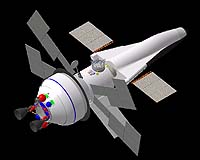
The new Crew Exploration Vehicle would be tested by 2008 and conduct its first manned mission no later than 2014, the White House has said. But NASA chief Michael Griffin has indicated that he would like a new spaceship ready much earlier.
Bush also outlined an ambitious plan to take astronauts back to the Moon as early as 2015 and eventually to Mars.
The current fleet – Discovery, Atlantis and Endeavour – is currently limited to missions on the ISS. NASA's space shuttles were put in service in 1981. The Columbia's destruction and the Challenger tragedy in 1986, in which seven other astronauts were killed, has left the agency with three spaceships.
Prior to the Columbia accident, NASA had wondered how to approach the White House to discuss replacing the shuttle fleet, said Howard McCurdy, and American University and expert on the history of the US space program.
"After the accident it became apparent that the shuttle would not be flown for much longer," McCurdy told AFP.
But the disaster actually precipitated the debate over replacing the fleet, and in the end NASA got what it wanted, he said.
Proving Bush's committment to space exploration, NASA is in an exclusive club with the Pentagon as US departments whose budgets were increased each fiscal year since the Columbia crash. The space agency's budget reached 16.5 billion dollars in fiscal year 2006.
The expensive human mission to Mars would launch after 2020, but the Moon mission could be financed through NASA's regular budget, according to a NASA document.
The funds for new US objectives would become available with money saved from the shuttle fleet's retirement and a reduction in ISS contributions.
Between 2006 and 2020, NASA's budget will total 154 billion dollars and two-thirds could be dedicated to exploration.
The cost of the Moon program from Apollo to Apollo 11 cost 150 billion in today's dollars, said McCurdy, author of "Faster, Better, Cheaper," an analysis of cost-cutting initiatives in the US space program.
In the 1960s, the space agency's costs included construction of the launch site in Cape Canaveral, Florida, and the mission control center in Houston, Texas.
"NASA plans to go back to the Moon for 43 percent of the cost of going the first time," McCurdy said, with "63 billion dollars for the first human back on the Moon."
