
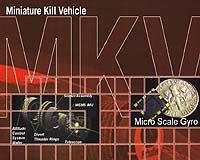
Lockheed Martin has achieved a key milestone for the U.S. Missile Defense Agency's Multiple Kill Vehicle-L (MKV-L) payload by successfully demonstrating engagement management algorithms in a software test bed environment in Huntsville, Ala.
During an engagement with the enemy, the MKV-L carrier vehicle with its cargo of kill vehicles is designed to maneuver into the threat complex to intercept the targets. With tracking data from the Ballistic Missile Defense System and its own seeker, the carrier vehicle dispenses and guides the kill vehicles to destroy targets in the complex.
The engagement management algorithms will perform tracking and discrimination, guidance and control, and battle management functions.
"This demonstration verified the ability of sophisticated algorithms to effectively manage the engagement of multiple kill vehicles," said Rick Reginato, Multiple Kill Vehicle program director, Lockheed Martin Space Systems Company.
"The use of test beds enables a disciplined, progressive approach to validating the key software and hardware components for this critical capability for the nation."
The team now will proceed with further algorithm development, followed by a real-time engagement management demonstration of the algorithms operating in a prototype flight computer with complex threat scenarios. Later demonstrations will incorporate the MKV-L carrier vehicle sensor hardware into the real-time test bed.
Lockheed Martin Space Systems Company, Sunnyvale, Calif., is the prime contractor for the Multiple Kill Vehicle-L payload system.
For MKV-L engagement management algorithm development, Lockheed Martin performs systems engineering and integration, algorithm development, model-based software development and software testing and integration; and MIT Lincoln Laboratory performs algorithm development.
