
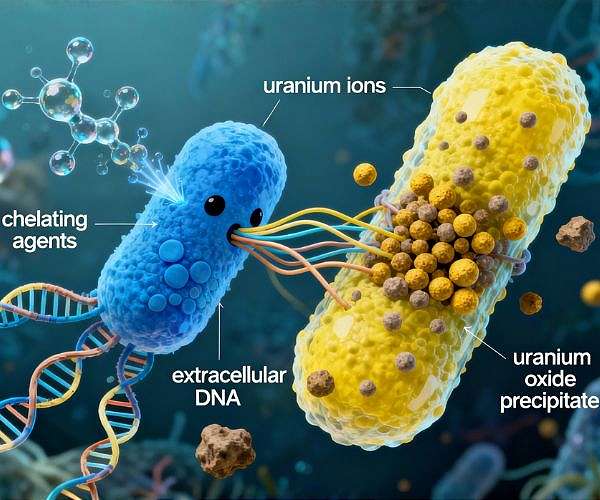
Chinese scientists have discovered a quick and effective way to remove toxic uranium from water using helpful bacteria that work together. These bacteria can change uranium from a dangerous form that dissolves easily in water to a safe solid that can be collected. In tests, this team-up removed all the uranium in just two days – about twice as fast as older methods with only one kind of bacteria.
One type of bacteria, called Pseudomonas, releases chemicals and DNA strands that help carry energy between cells. The other, Shewanella, uses these "wires" to boost its own cleanup power. By passing signals and energy to each other, the microbes work as an efficient cleaning crew, turning toxic dissolved uranium into a harmless solid that settles out of water.
The scientists found that the mix of bacteria cleaned up 75 percent of the uranium in 12 hours and finished the job in 48 hours. They studied how pyocyanin chemicals and DNA strands from Pseudomonas interact with Shewanella cells to pass electricity and energy more quickly, making the process more effective. Genetic tests showed higher activity in the cells' energy systems, helping them lock away uranium.
"Our results show how naturally occurring microbial interactions can be used to improve metal reduction efficiency," said Dr. Xizi Long, corresponding author of the study. "By combining Shewanella and Pseudomonas, we achieved a balance between metabolic complementarity and electron transfer enhancement. Pyocyanin functions as an intercellular redox mediator, while extracellular DNA provides a conductive matrix. This cooperative design illustrates how microbial communities can be organized for more effective environmental remediation."
This new cleanup method could help treat polluted water and soil where uranium or other heavy metals like chromium or arsenic are present. Using teams of microbes for cleanup could also one day lead to better green technology solutions.
Research Report: Complete uranium bioreduction in 48 hours: Synergistic electron transfer in a synthetic microbial consortium
