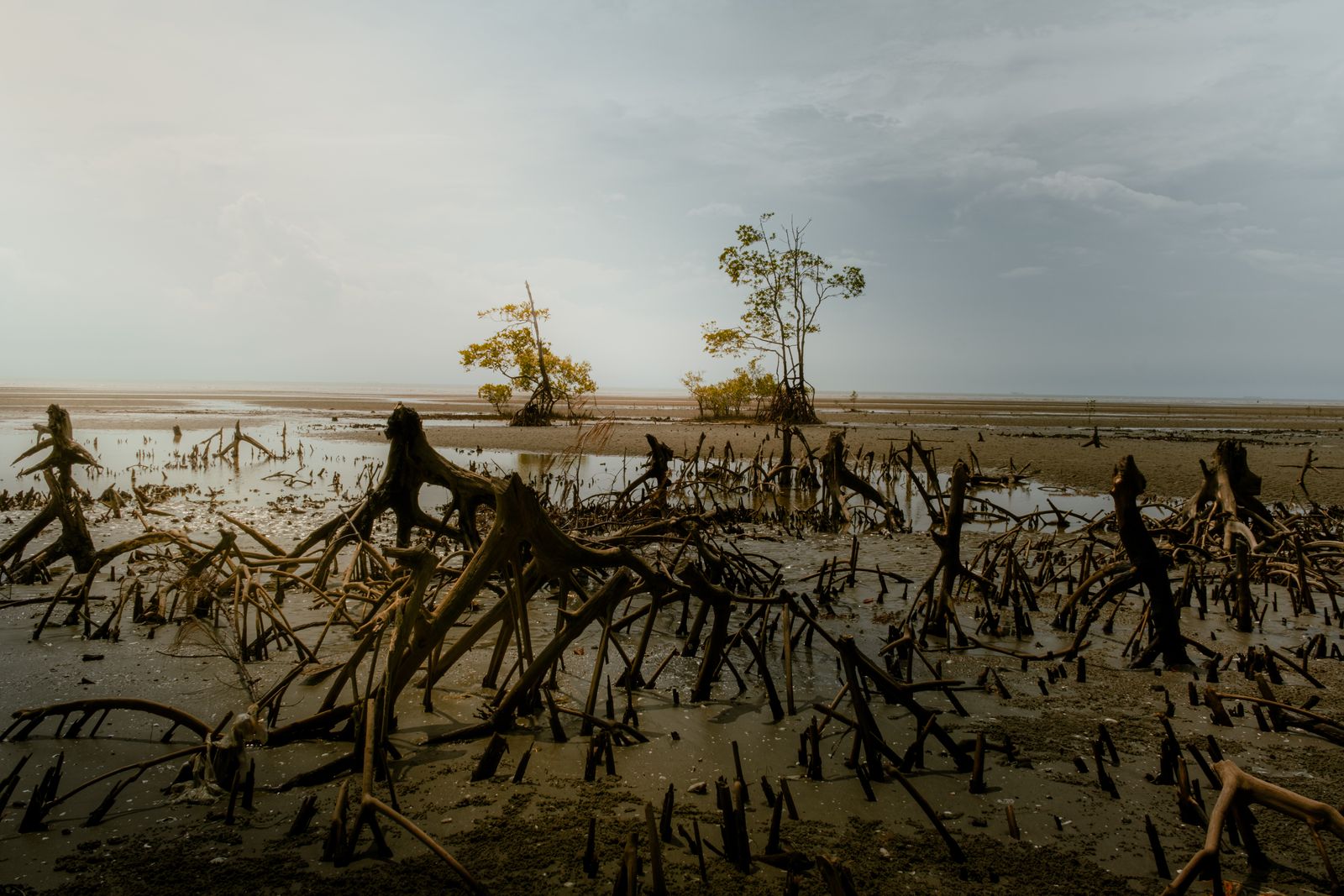
A red mangrove standing in the tidal shallows of Colombia’s Pacific coast, its stilt roots half-submerged in brackish water, can lock away between 1,000 and 1,500 tonnes of carbon per hectare across the whole ecosystem — soil, roots, trunk, and canopy combined. A hectare of Amazon rainforest, growing on solid ground a few dozen kilometres inland, holds closer to 300 tonnes. The mangrove is smaller, scrappier, and often only ten metres tall. It still wins, by a factor of three to five, because almost none of its carbon is stored in the wood you can see.
The trick is beneath the waterline. Mangrove forests cover less than 1 percent of Earth’s land surface but hold roughly 15 percent of the carbon stored in ocean ecosystems, and the vast majority of that carbon sits not in the trees but in metres-deep, oxygen-starved mud, according to a 2026 University of Exeter modelling study published in Earth’s Future. Salt water, in other words, is the storage vault.
The rainforest burns its own carbon
A tropical rainforest is a spectacular biomass machine. It stacks carbon into wood — buttressed trunks, canopy branches, lianas — and into a shallow layer of leaf litter on the forest floor. That leaf litter looks generous but it is thin, often only a few centimetres deep, because the soil beneath it is warm, moist, and full of oxygen. Fungi, termites and bacteria tear through fallen leaves within weeks. The carbon comes down and goes back up.
The Amazon holds most of its carbon above ground, in the trees themselves. When a tree falls, the CO2 it contained is on a short leash. Fire, decay, or a chainsaw releases it in years, not centuries. The soil, meanwhile, is famously poor — thin, acidic, and dependent on windblown minerals to stay fertile at all. Saharan dust crosses the Atlantic on trade winds to supply phosphorus that helps sustain the rainforest. The rainforest’s carbon economy is aboveground and fast.
The mangrove buries its carbon in anoxic mud
A mangrove ecosystem inverts the arrangement. The trees themselves are modest — Rhizophora, Avicennia, Sonneratia, rarely more than 20 metres tall, often much shorter. What matters is what happens beneath the stilt roots. Twice a day, the tide comes in and floods the forest floor. Twice a day, it goes out. In between, the sediment sits saturated with salt water and starved of oxygen.
Leaf litter, dead roots, and organic debris fall into this waterlogged mud and simply stop decomposing. The bacteria that would shred them in an aerated rainforest soil cannot function in the anoxic layer. Fungi drown. Termites do not swim. Carbon that would return to the atmosphere in three years in the Amazon instead sits in a mangrove sediment column for three thousand years — sometimes far longer.
The soils accumulate downward. A mangrove peat can reach five metres or more, and every centimetre of it is dated carbon that never got the chance to oxidise. A 2026 study of mangrove soils in the Zhangjiang Estuary in China found that even black carbon — the highly stable residue of wildfires and fossil fuel combustion — persists in mangrove sediments at concentrations of 0.95 to 1.67 grams per kilogram, with the most chemically resistant forms concentrated in the deeper layers.
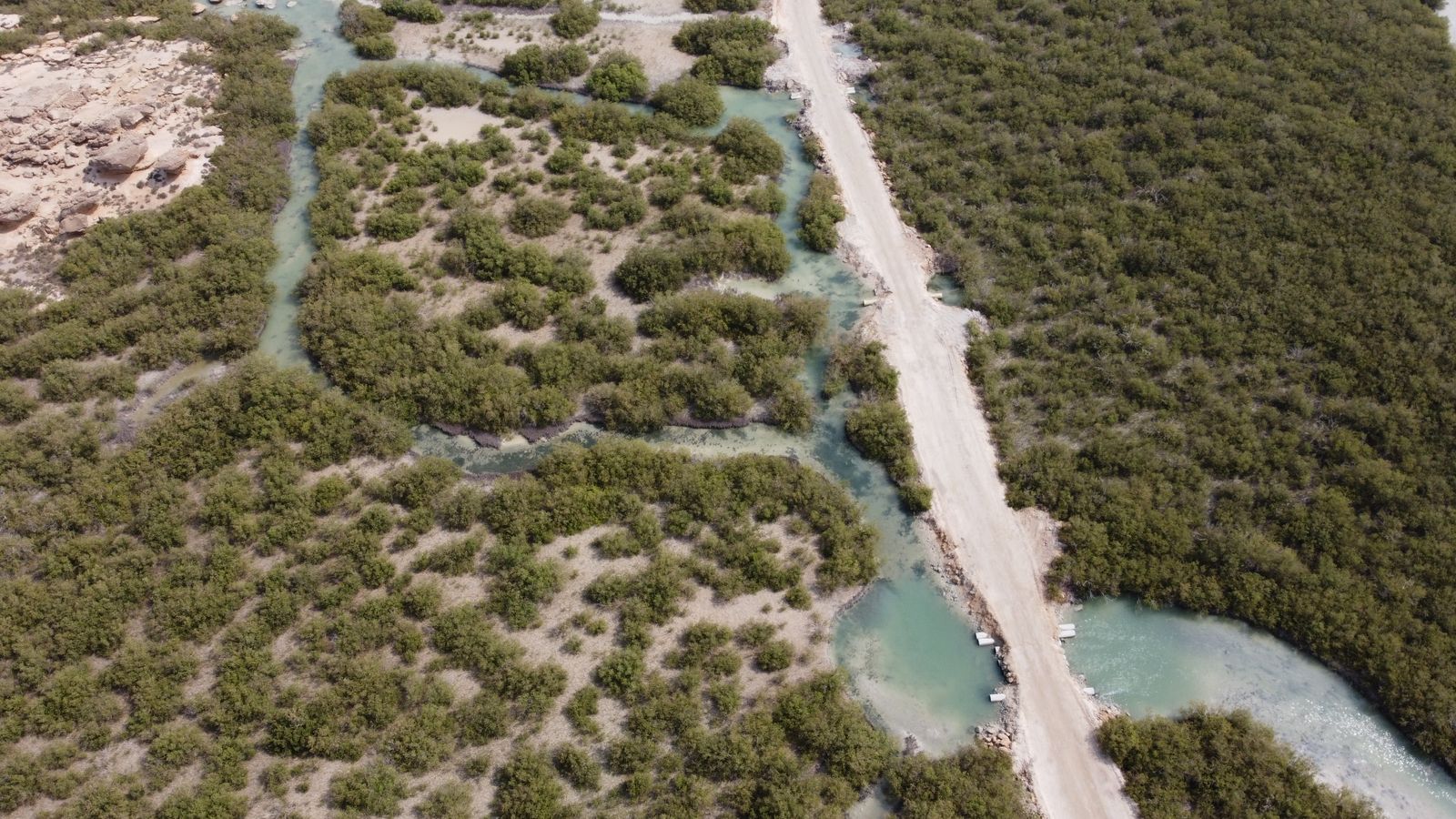
The mechanism that makes mangroves so effective is not the tree but the flooding regime. Tidal inundation does three things at once. It brings in fine sediment from rivers and offshore, which piles up around the roots and buries organic matter. It excludes oxygen from that sediment, halting decomposition. And it deposits salt, which limits which microbes can operate at all.
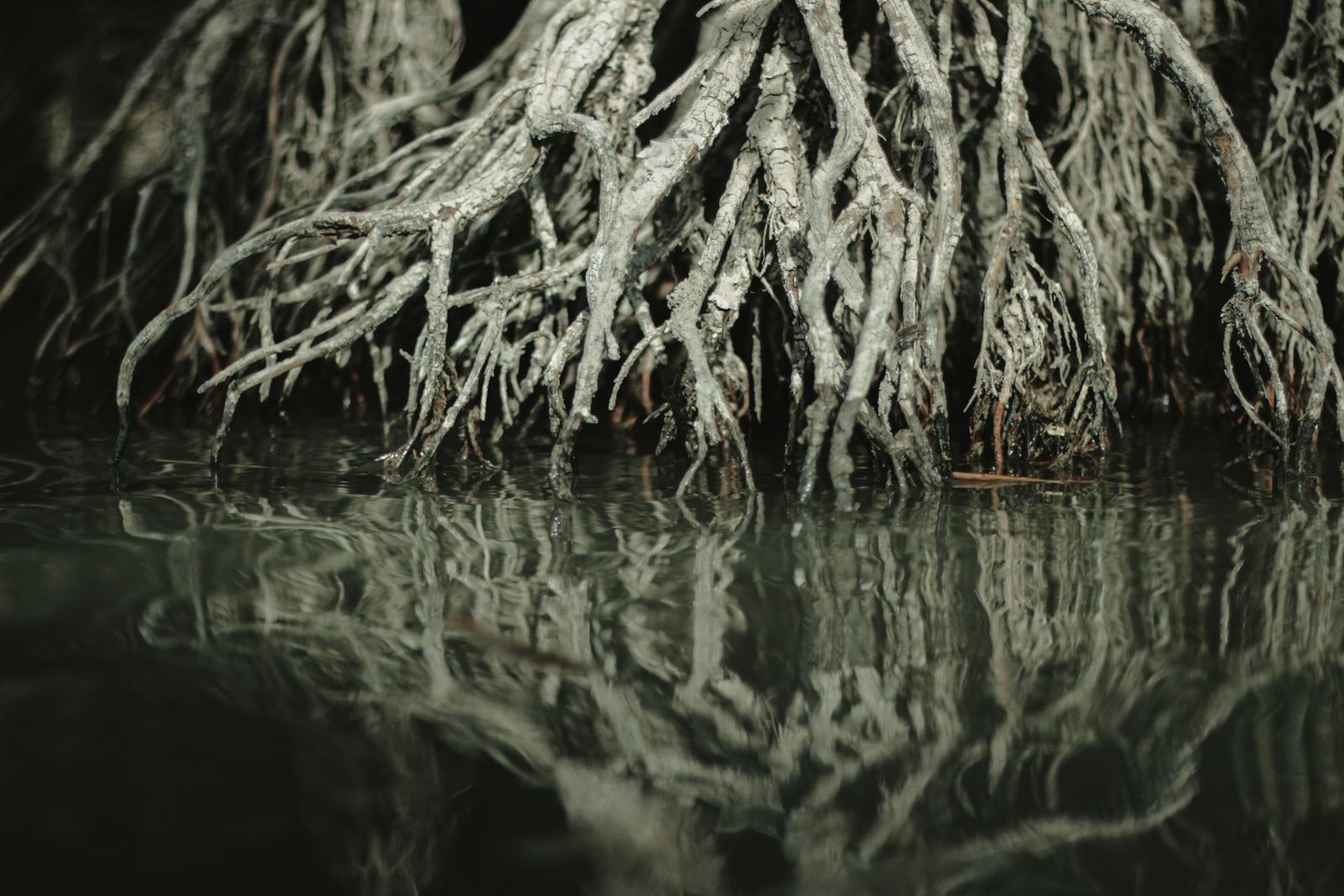
The trees themselves are adapted to conditions that would kill an inland species. Red mangroves push oxygen down to their roots through their above-water prop structures. Black mangroves grow pneumatophores — pencil-like snorkels that stick up out of the mud. This lets the trees live in the same anoxic sediment that preserves their fallen leaves. The forest and the vault are the same place.
The same waterlogged-storage principle explains why peatlands are such outsized carbon reservoirs. Waterlogging is the shared trick. Mangroves are peatlands with salt and tides.
The numbers, forest by forest
Mangrove ecosystems can store 800 to 1,500 tonnes of carbon per hectare when accounting for the whole system — soil, roots, trunk, and canopy — with the soil column contributing the vast majority, and researchers have measured whole-ecosystem stocks of around 1,000 tonnes per hectare, three to five times the carbon held by terrestrial forests. Tropical upland forests, by contrast, typically store most of their carbon in biomass rather than soil.
The multiplier is not uniform. Older, sediment-rich mangroves along muddy delta coasts store more than young mangroves on sandy shorelines. A 2025 international study in Nature Communications found that conserving and restoring Southeast Asia’s peatlands and mangroves together — occupying just 5 percent of the region’s land — could cut more than half of the region’s land-use carbon emissions.
Brazil’s mangrove belt, stretching along thousands of kilometres of coastline from Amapá to Santa Catarina, has been shown in field surveys to sequester carbon at rates that outpace the Amazon rainforest itself on a per-hectare basis, even as they remain almost invisible in national climate accounting.
The same trees, doing several jobs at once
Carbon is only one of the elements mangroves quietly filter. A 2026 study by Ziyan Wang and Benoit Thibodeau estimated that the world’s remaining mangroves currently sequester around 870,000 tonnes of nitrogen every year — mostly runoff from synthetic fertilizer and sewage that would otherwise fuel algal blooms and dead zones. Restored and protected mangroves could pull that figure above 5 million tonnes, an ecosystem service the authors valued at more than $8 billion annually.
The nitrogen storage runs on the same anoxic-mud engine. Denitrifying bacteria in the waterlogged sediment convert nitrate to nitrogen gas, which escapes harmlessly to the atmosphere, while the sediment traps the rest. The dead zones that plague the Gulf of Mexico, the Baltic, and the Gulf of Thailand form in coastlines where mangroves have been cleared away.
The same forests are also physical infrastructure. Mangrove belts absorb wave energy, blunt storm surges, and hold shorelines together with their root mats. Bangladesh, after a catastrophic 1991 cyclone, expanded coastal mangrove planting alongside cyclone shelters and village warning networks — a layered defence that has helped reduce cyclone mortality in subsequent storms.
The storm defence and the carbon storage are the same trees. So is the nitrogen filtration, the nursery habitat for reef fish, and the fibre and honey and crabs that support tens of millions of coastal livelihoods. Researchers note that mangroves serve multiple critical functions: they store significant amounts of carbon, protect coastlines from storms, support coastal community livelihoods, and provide habitats for diverse species.
The vault has a lid, and the lid is fragile
The catch is that mangrove carbon is only safe as long as the mud stays wet, salty and undisturbed. Clear the trees for a shrimp pond and the soil dries, oxygen rushes in, and centuries of buried carbon oxidises within a few years. Cut a drainage channel and the same thing happens. The forest that took a thousand years to build its vault can empty it in a decade.
Rising seas are the other threat. The Exeter team’s three-in-one model — coupling water flow, sediment transport, mangrove growth and dieback, and carbon dynamics — found that under higher IPCC sea-level scenarios, mangrove forests lose their ability to keep pace. According to research on mangrove survival, these specialized plants require specific flooding durations with each tide to thrive, and exceeding these thresholds can make locations unsuitable for growth. Research indicates that when flooding periods exceed tolerable levels, mangroves can experience dieback as the plants effectively ‘drown’ in unsuitable conditions.
When that happens, the anoxic seal breaks. Waves erode the exposed peat. Carbon-rich sediment washes out into the water column, where it meets oxygen and returns to the atmosphere as CO2. A carbon sink becomes a carbon source, and it does so without any human touching it directly.
What the multiplier really means
Three to five times more carbon per hectare, packed into a forest that is often knee-high compared to the Amazon canopy. The rainforest is doing its work in the air; the mangrove is doing its work in the mud. One is a stockpile you can see and count. The other is a stockpile you have to drill a core to find.
Hectare for hectare, Latin America’s mangroves hold some of the densest carbon stocks measured anywhere, far outweighing the tropical forest that grows beside them, and researchers have been pushing for these overlooked ecosystems to be given a formal climate role in national accounting, restoration finance, and blue carbon markets.
Walk out at low tide into a Colombian or Sundarbans mangrove and the ground will squelch under your boots. The mud is black and it smells faintly of sulphur. Push a stick in and it goes down half a metre before it stops. Every centimetre of that black, sulphurous muck is carbon that fell as a leaf sometime during the last few thousand years and never got out again — locked in by salt, by tide, by the absence of oxygen, and by a tree that learned to breathe through its knees.