On October 24, 1946, a 35-millimetre DeVry motion-picture camera riding inside a captured German V-2 rocket recorded a frame at a time as the missile climbed 65 miles above the New Mexico gypsum, tumbled at apogee, and fell back toward the desert. The camera was the work of Clyde T. Holliday and a small team from the Applied Physics Laboratory at Johns Hopkins, and the answer to how the film survived is unglamorous: it never rode the crash down. Explosive charges ejected the camera and its armour-plated film canister during descent, and both fell separately to the desert floor while the spent rocket cratered roughly 17 miles downrange. Recovery teams found the canister intact. Developed at White Sands Proving Ground, the film held the first photographs of Earth ever taken from above the atmosphere.
The rocket beneath the camera had been assembled from parts hauled out of the Mittelwerk, the underground V-2 plant in central Germany, in the spring and summer of 1945. American forces reached the site ahead of the Red Army and shipped out roughly 300 railway cars of hardware, enough by some estimates to build a hundred missiles. None arrived flyable. The V-2 stood 46 feet tall, weighed more than 12 tonnes fuelled, and burned liquid oxygen and ethanol for about a minute. The camera weighed a few pounds.
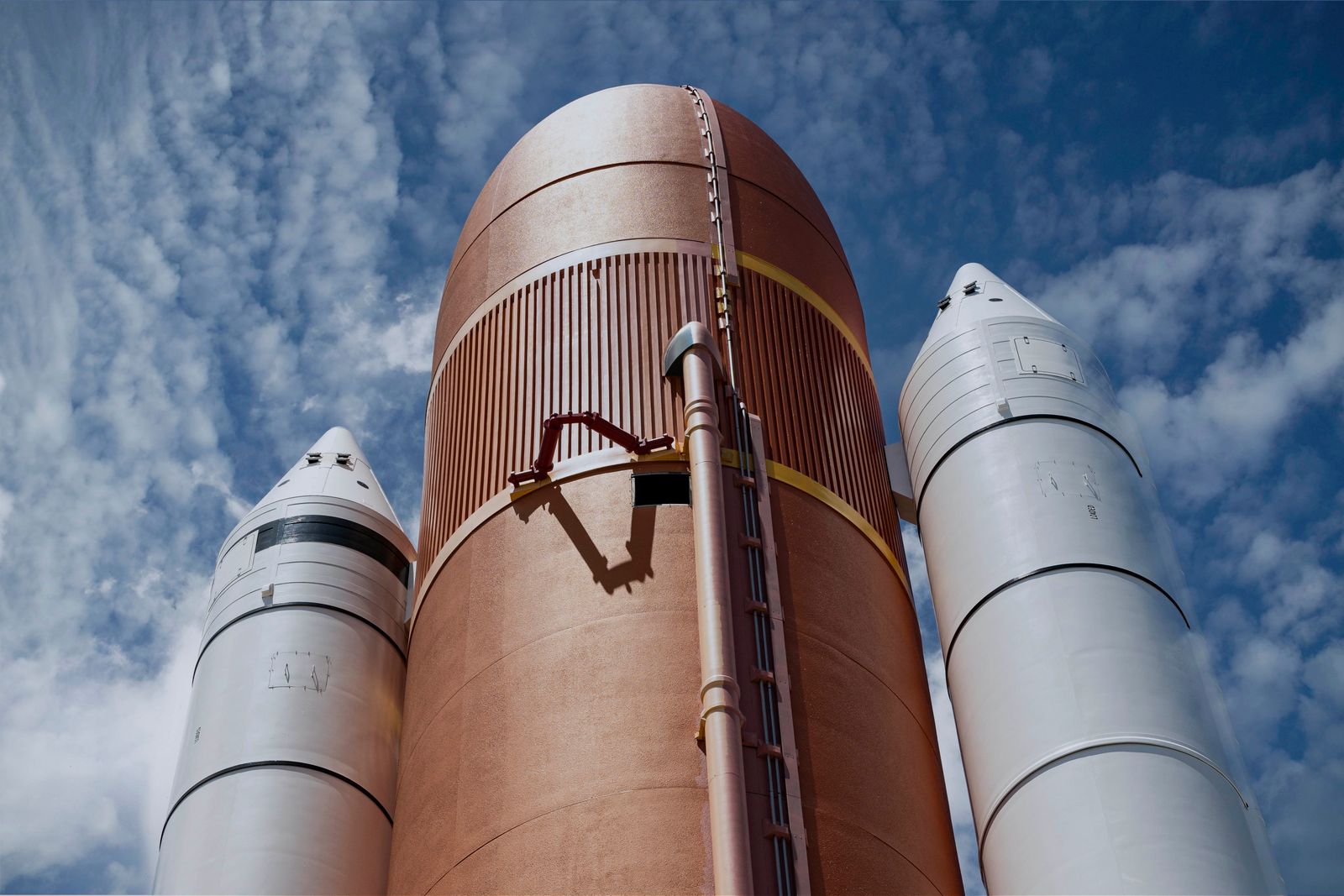
How a wartime missile ended up in the New Mexico desert
The V-2s that flew from White Sands were not built in America, and they were not delivered as rockets. They arrived as freight, to be sorted, assembled and test-fired by General Electric under Army Ordnance contract. Wernher von Braun and his engineers were housed at Fort Bliss, Texas, and bused across the state line to work on reassembly. German personnel at the proving ground peaked at 39 in March 1946, and were steadily replaced by American contractor staff over the following year.
The first ignition of a V-2 engine on American soil was a static test on March 15, 1946. Lt. Col. Harold Turner, the first commander of White Sands, invited 500 military personnel and 100 Las Cruces community leaders to watch a rocket bolted to a stand. According to the White Sands Missile Range Museum’s account of the demonstration, the motor ran for 57 seconds, the steel plates lining the flame duct glowed red and tore loose from their bolts, and they sailed out into the desert toward the spectators, who scattered. The plates landed short but started brush fires within 200 yards of the stand. Turner was standing beside Maj. Gen. Gladeon Barnes, his Washington-level boss in the Ordnance Corps. He said afterwards that he had never seen a general dive under a truck so fast.
The first free launch came a month later, on April 16. A steering vane broke six seconds in, a fin came off at eleven, and the engine was cut at nineteen; the rocket reached 3.4 miles and crashed near the launch site. The second, on May 10, was the one that worked. It burned for 59 seconds, reached 70.9 miles, and travelled 31 miles downrange, higher than anything the United States had put aloft. In all, NASA’s history office counts 67 V-2s launched from White Sands before the last flight on September 19, 1952.
Clyde Holliday’s camera
By the summer of 1946, White Sands had become a queue. Universities, the Naval Research Laboratory, the Air Materiel Command and the Applied Physics Laboratory all wanted room aboard rockets that had been designed to carry a one-tonne warhead. The rockets themselves were surplus. Each flight bought a few minutes of ballistic arc, only two or so of them above 50 miles, and there was no second chance on any of it.
Holliday was an aerial-photography specialist, not an astronomer, and his stated objective was practical: find out whether pictures from that altitude were any use for meteorology and long-range reconnaissance. Working with J. Allen Hynek, he chose a commercially available DeVry 35mm cine camera because it had already proven flightworthy and could be automated using parts scavenged from a B-29 gun director. Air & Space Magazine describes it snapping a new frame every second and a half, running as a time-lapse rather than a movie.
The engineering problem was not the exposure. It was the return. V-2s did not come back gently: they arced up, ran out of fuel, coasted through apogee, then fell nose-first, digging craters in the gypsum. APL’s answer was not to armour the rocket but to get the film out of it. The camera sat in a steel box in the rocket’s mid-section, between the propellant tanks, with its exposed film winding into an armoured drum, and the whole assembly was rigged to be thrown clear during the fall.
What came back on the film
V-2 #13 lifted off at 12:15 p.m. Mountain time carrying Holliday’s camera, a pair of Geiger counters, a solar ultraviolet spectrograph, and a device that puffed smoke on the way up to trace high-altitude winds. The engine ran to propellant depletion 59.8 seconds after launch, by which point the rocket was 27 kilometres up and moving at 1,216 metres per second. It coasted to a peak of 105 kilometres about three minutes into the flight, clearing not only the 50-mile line the U.S. Air Force would later use for astronaut status but the 100-kilometre Kármán line itself.
Then it came apart on schedule. The camera and its protective enclosure were ejected at around 25,000 feet and free-fell to the desert floor, where the recovery team located them 17 miles from the launch site, the film safe inside its inch-thick armoured canister. Accounts differ on how the camera itself fared: one contemporary reconstruction has it destroyed along with its drive motor, while the detailed flight record has it found within hours in good order apart from a missing lens.
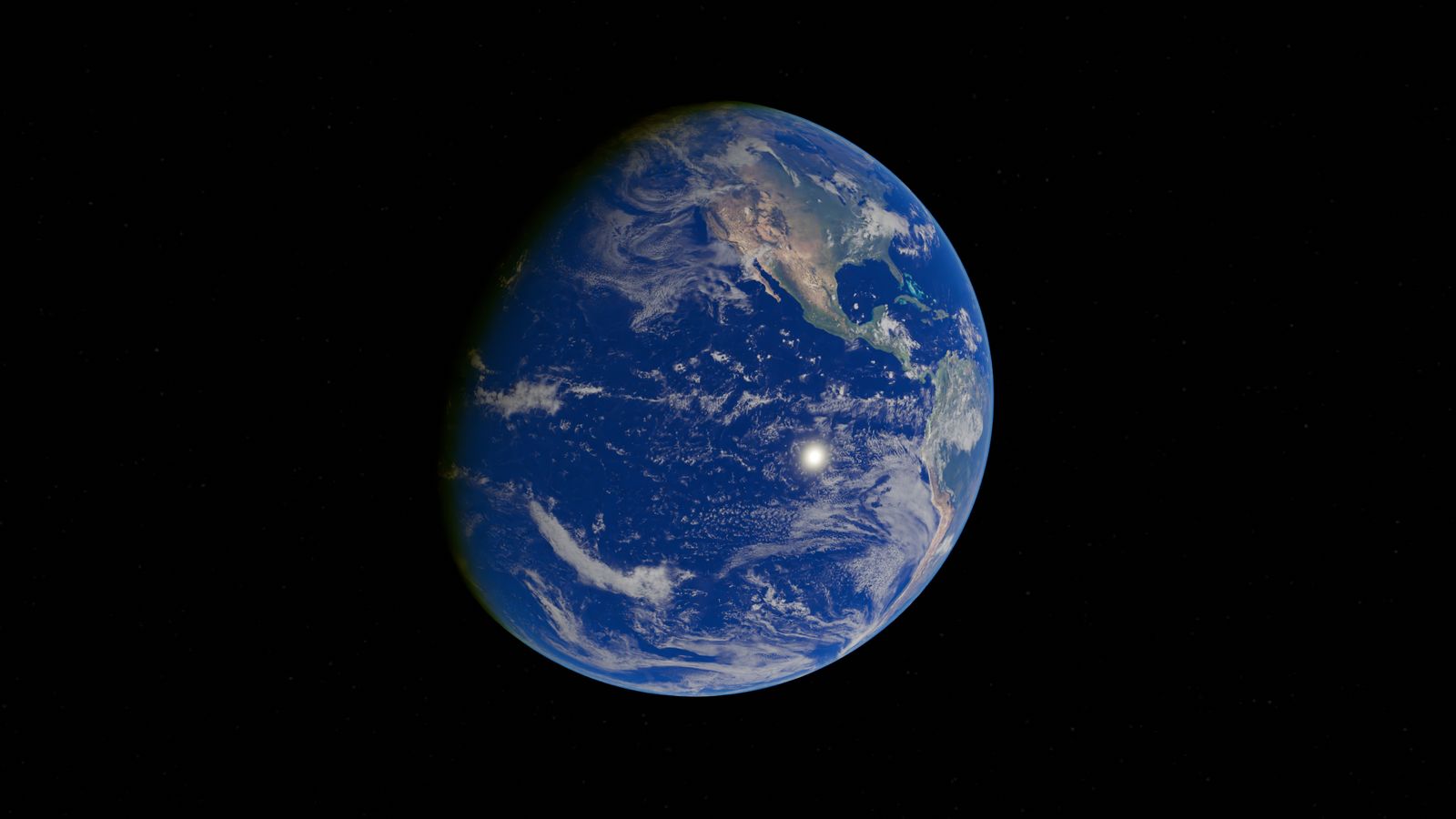
What was on the film was not the sweeping stitched panorama that later became the emblem of this story. That mosaic came from V-2 flights in 1947 and 1948. The October 1946 haul was a time-lapse record of a tumbling rocket, from which APL released a handful of stills in November taken at 48, 72 and 104 kilometres. The highest of them is reckoned to cover some 2.8 million square kilometres of the American southwest. Explorer II had already shown the curve of the Earth from a balloon at 13.7 miles in 1935. What was new at almost five times that altitude was the planet set against the blackness above it.
Fred Rulli was a 19-year-old enlisted man on the teams that drove out to retrieve film from those early V-2 shots. When the scientists found a cassette in good shape, he told Air & Space decades later, “They were ecstatic, they were jumping up and down like kids.” Back at the launch site, when the frames first went up on the screen, he recalled that the scientists simply went nuts. At 19 it had seemed to him like another Army job.
Holliday published a selection of the images in National Geographic in October 1950, under the title “Seeing the Earth from 80 Miles Up.” He was sparing with the word “space,” preferring to describe the little-known reaches of the upper air, and he framed the pictures mostly as a technical proposition: cameras on missiles for reconnaissance, for mapping, for watching storm fronts across a whole continent. He also allowed himself one line that outran his caution, writing that the results showed how our Earth would look to visitors from another planet coming in on a space ship.
The queue behind the camera
Holliday’s flight was one payload among dozens, and the photographs were not even the program’s main scientific yield. Instruments carried on other V-2s from the same range returned the first solar ultraviolet spectrograms taken above the atmosphere, along with cosmic-ray measurements and readings of pressure, temperature and density at altitudes no instrument had reached. S. Fred Singer, then at APL, spent his time analysing Holliday’s frames not for the view but to work out which way the rocket had been pointing. Clouds, he said, were considered a nuisance.
Living payloads followed quickly. On February 20, 1947, fruit flies rode a V-2 in the first Blossom capsule and came down by parachute alive, the first creatures recovered from a spaceflight. Mice and rhesus monkeys came after them, with mixed results: Albert II reached 83 miles on June 14, 1949, and was killed when his parachute failed on descent.
The British nearly turned the same rocket into a crewed vehicle. In 1946 Ralph Smith of the British Interplanetary Society, building on an idea from H.E. Ross, proposed Megaroc, a reinforced V-2 with a widened hull, no fins, and a single-seat pressurised capsule where the warhead had been, aimed at an altitude of 186 miles. Astronomy Magazine has traced the design down to its peroxide attitude thrusters and its parachute recovery scheme. It was never funded. A near-bankrupt Britain was putting its money into atomic weapons and the bombers to carry them. Had Megaroc flown, a Briton might have reached space around a decade before Yuri Gagarin reached orbit.
Why Sputnik gets the credit anyway
Ask when the space age began and most people say October 4, 1957. That answer flattens more than a decade of work in the Tularosa Basin. The History News Network has argued that the space age began substantially earlier, pointing to the White Sands V-2 flights, the Bumper two-stage rocket that reached 244 miles from the same range on February 24, 1949, and the animals that flew and in some cases came home years before Laika. Part of the reason none of it stuck, as that account concedes, is that nobody had yet agreed where space started, so these were filed as high-altitude flights. Part of it was that the rockets were German.
The distinction is also real. Sputnik was about orbit, a satellite going round. Holliday’s frames were about perspective, a species looking back. William Anders’ Earthrise from Apollo 8 in December 1968 gets the credit for changing how humans see their planet, and it deserves it in a way a grainy time-lapse from a tumbling missile never could. But the October 1946 film was the first draft, and it was in hand twenty-two years earlier.
The V-2 launches ended in September 1952, by which time the German parts were used up and American designs, the WAC Corporal, the Aerobee and eventually the Redstone, had taken over. The Army moved von Braun’s team to Redstone Arsenal in Huntsville, Alabama, where they would build the Saturn V. Launch Complex 33, where all of it happened, is a National Historic Landmark.
Landing rockets under their own power, the trick that ends every Falcon 9 flight now, took another 69 years to work out. The choreography of a first stage settling onto a pad while the second stage carries on to orbit would have been unimaginable to the crews scraping V-2 wreckage out of the White Sands gypsum.
What is still out there
The film was 35 millimetres wide, but these were cine frames, each one roughly 22 millimetres across and smaller than a modern 35mm still negative. The resolution is what you would expect from mid-1940s motion-picture stock exposed through a porthole on a spinning rocket. Arranged in sequence, the horizon curves.
The images sit in a lineage of small, decisive pieces of film. In 1952 Raymond Gosling, working with Rosalind Franklin at King’s College London, produced Photo 51, the X-ray diffraction pattern that pointed to the double helix: another case where an emulsion exposed under awkward physical conditions rewrote what humans thought they were looking at. Mars Daily’s account of Le Verrier’s 1846 prediction of Neptune follows the same pattern, a single measurement pushed to a place no measurement had reached, redrawing the reference scale behind it.
Pieces of the rocket that carried the camera are presumably still half-buried in gypsum north of the old complex, eighty years on. The frames themselves, digitised and rescanned, circulate freely online.
The trajectory that produced them was ballistic and unaimed, straight up and then straight down, and the rocket rotated as it climbed, which is why the exposures do not line up cleanly. The timer did not know or care whether the lens was pointed at the sun, the desert, or the blackness above. Every second and a half, the shutter fired. Some frames caught the ground. Some caught the sky. A few caught the seam between them, and those are the ones that went up on the screen, with the scientists going nuts.
The V-2 had been built to kill people in London and Antwerp. On October 24, 1946, one of them was pointed at the sky over New Mexico with a newsreel camera wedged between its fuel tanks, and it threw back, on 35mm emulsion, the first evidence of what the planet looks like from outside itself.