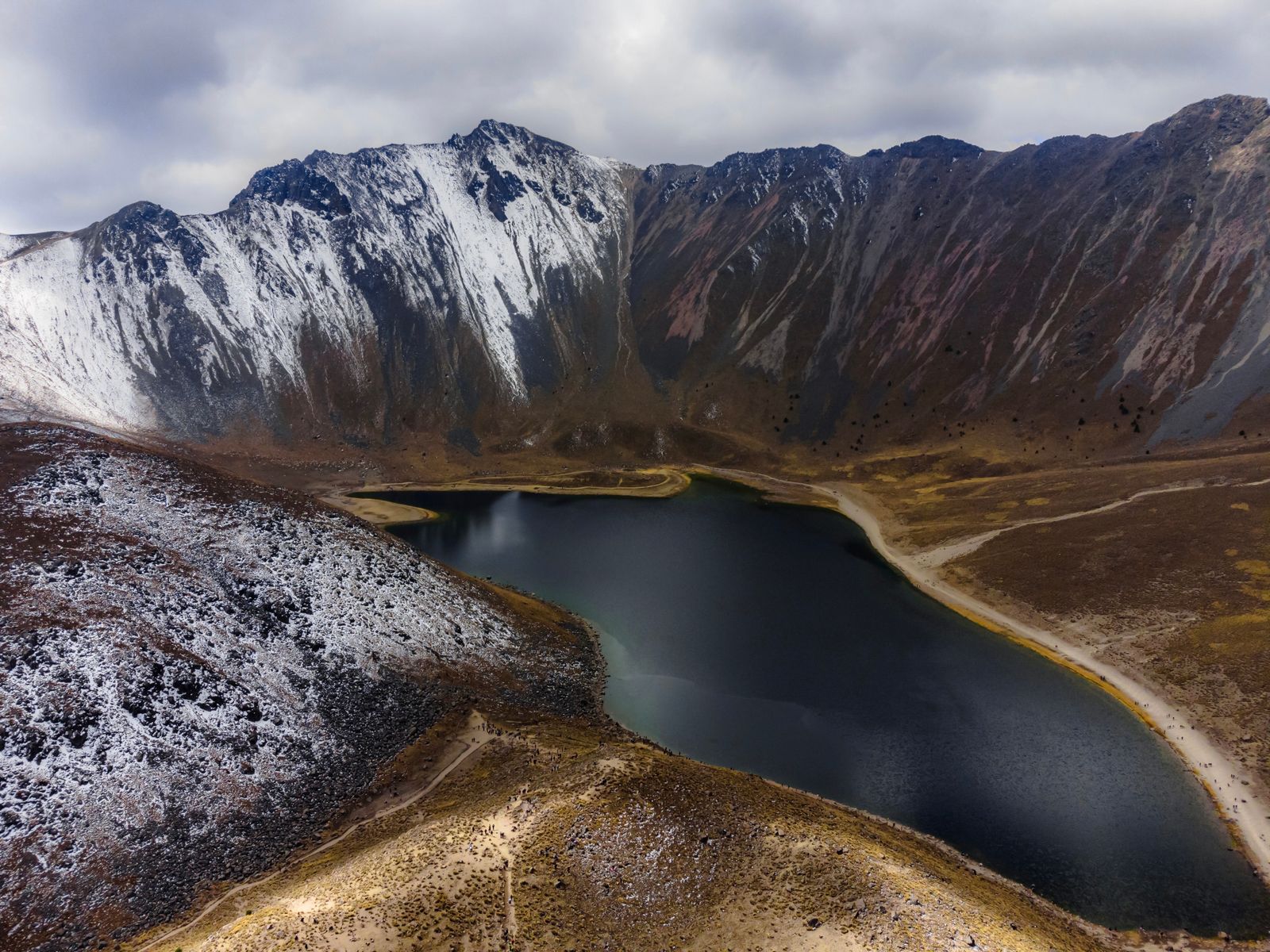
On the night of August 21, 1986, a crater lake in the volcanic highlands of northwest Cameroon exhaled a cloud of carbon dioxide so vast and so dense that it flowed downhill like water, hugged the valleys, and smothered 1,746 people before most of them woke up. Every cow in the surrounding villages died. Every dog. Every bird. Even the flies on the corpses were dead by morning, according to survivors interviewed by Smithsonian Magazine.
The lake was Nyos. It made no explosion anyone would recognise as one. It made a rumble, a mist, and a silence.
A cloud that behaved like a liquid
Carbon dioxide is about 1.5 times denser than air. When a massive volume of it burst out of Lake Nyos in a matter of minutes, the gas did not rise and dissipate. It poured over the crater’s low northern rim and ran downhill, following the terrain the way a flash flood would.
The cloud moved rapidly downhill, reaching villages up to 25 kilometres away. In the valleys it pooled deep enough to displace all breathable air for hours.
People in Lower Nyos, Cha, Nyos, and Subum were asleep or eating dinner or tending livestock. High concentrations of CO2 cause rapid unconsciousness and death. The cloud that rolled through these villages was far denser than survivable levels.
Ephriam Che, a farmer who lived on a cliff above the lake, told Smithsonian he heard what sounded like a rockslide around 9 p.m., saw a strange white mist, felt ill, and went to bed. By first light he walked down into a landscape where his parents, his siblings, and the residents of Lower Nyos were dead in the positions they had been in when the gas arrived — near cooking fires, in doorways, in bed.
The final count
Different sources cite slightly different figures, because bodies were still being counted for weeks and some victims died later of respiratory injuries. The most frequently cited toll is 1,746 people, though some accounts round to 1,800. Roughly 3,500 head of livestock died alongside them, according to Voice of America’s reporting on the 30th anniversary.
Survivors described a totality that scientists arriving days later found hard to believe. No birdsong. No insects. Cattle dead in their pens with no external injuries. Vultures did not come, because there were no vultures left within range.
Some people who lay unconscious for more than a day woke to find every member of their family dead around them.
What is a limnic eruption
The scientific term for what happened at Nyos is a limnic eruption, and before 1986 it existed mostly as a theoretical curiosity. Lake Nyos and its smaller cousin Monoun, also in Cameroon, have both experienced limnic eruptions. Lake Kivu on the Rwanda–DR Congo border also holds dissolved gas and sits in a densely populated region.
The mechanism works like a bottle of sparkling water. Nyos sits inside the crater of a dormant volcano. Magma several kilometres below the lake bed leaks carbon dioxide upward through fractures in the rock. That CO2 dissolves into the deepest, coldest layer of the lake, which is under enough pressure from the water above to hold gas in solution the way a sealed bottle holds carbonation.
The lake stays stratified. The bottom layer, saturated with gas, does not mix with the surface. It sits there, silently loading, for decades or centuries.
Then something disturbs it. A landslide, a cold rain, an internal wave — the exact trigger at Nyos in 1986 is still debated. Whatever it was, a plug of gas-rich water rose slightly. As it rose, the pressure on it dropped. CO2 came out of solution as bubbles. Those bubbles made the water lighter, which made it rise faster, which released more bubbles. The process runs away in seconds.
IFLScience describes the eruption as the lake essentially uncorking itself. A column of water shot high into the air. The lake surface dropped noticeably. And an invisible flood of CO2 — heavier than air, colder than the night — began its slow descent into the valleys.
The two years of confusion before
Two years earlier, on August 15, 1984, something similar had happened at Lake Monoun, 95 kilometres south of Nyos. Thirty-seven people died on a road that dipped through a low stretch near the lake shore. Survivors described finding corpses and dead animals in the low-lying areas.
The Cameroonian government suspected a chemical attack. The U.S. embassy called in Haraldur Sigurdsson of the University of Rhode Island. When Sigurdsson pulled a water sample from the lake bottom, the lid popped off the bottle. The water was carbonated.
Sigurdsson concluded that dissolved volcanic CO2 had erupted from the lake and asphyxiated everyone in the low ground. A few months later, Nyos killed fifty times as many people, and the phenomenon was no longer speculative.
Why a Mars publication cares about a lake in Cameroon
Carbon dioxide is the dominant gas in the Martian atmosphere — about 95 percent by volume, thin enough on Mars that a human would asphyxiate in seconds without a suit. Nyos is a rare terrestrial example of what a dense CO2 environment does at ground level to lungs, engines, and combustion. Candles will not burn in it. Petrol engines stall. In the villages below Nyos, kerosene lamps went out, which is one of the ways investigators later reconstructed the timing of the cloud’s arrival.
The behaviour of the gas — pooling in depressions, flowing along topography, refusing to mix with surrounding air — is also relevant to any study of how volatiles move in low-atmosphere or vacuum-adjacent conditions. Mars Daily has covered how liquid water may still exist below the Martian surface, and the same physics that traps gas under Lake Nyos — pressure, stratification, a stable cold layer — governs how volatiles might be held in reservoirs on other worlds.
The engineers who defused it
After the disaster, a small international team led by French engineer Michel Halbwachs designed a solution that is almost absurdly simple. They lowered a pipe from a raft on the lake’s surface down to the gas-saturated deep water far below.
Once primed with a pump, the pipe becomes self-sustaining. Deep water rises through it. As it rises, dissolved CO2 comes out of solution and pushes the water upward faster, like a soda fountain. The lake essentially degasses itself through a straw. A jet of foam shoots high into the air above the raft. The gas dissipates safely into the atmosphere at a rate slow enough that no cloud forms.
Multiple pipes have been installed at Nyos. The system at Lake Monoun was completed earlier and that lake is now considered largely defused. Popular Mechanics has documented the degassing effort in detail, including the years of political and funding struggles that delayed installation.
The problem that has not gone away
Nyos has another problem. Its natural dam — a wall of weathered volcanic rock on the northern rim — is eroding, raising concerns about the lake’s long-term stability and the potential threat to downstream populations.
Survivors, meanwhile, have spent nearly four decades in limbo. Many were resettled in camps far from the lake. Some have moved back to farm the fertile crater soil despite government warnings. Voice of America found in 2016 that promised compensation had never fully arrived and that survivors wanted permission to return home. The government’s position was that the lake remained toxic.
The degassing pipes have lowered the CO2 charge in the deep water substantially, but Nyos will keep being fed by the magma below. The pipes are a maintenance job, not a cure. If they stop, the lake will slowly reload.
The silence people describe
What survivors return to in interviews, again and again, is not the noise of the eruption. It is the quiet that came after.
Che told Smithsonian that the morning after, there were no flies on the dead. Suley, the cowherd who lost her four children and 31 other relatives in a single night, was found by Che stripped naked in grief, shaking her father’s body to try to wake him. The waterfall that drained the lake had run dry, because the eruption had temporarily lowered the surface below the spillway. The songbirds were gone. The insects were gone.
The 26th-anniversary reporting from EnviroNews Nigeria collected accounts from villagers who described walking through their own communities the next morning and finding, in effect, dioramas — bodies arranged as they had been at 9 p.m., untouched by predators because the predators were dead too.
A single night, measured in atmospheres
The cloud that came out of Lake Nyos on August 21, 1986 was an enormous volume of carbon dioxide — released in under two hours, at a temperature colder than the surrounding air, moving downhill rapidly. It killed everything that breathed within an area larger than the city of Paris intra-muros.
And then it thinned. By late morning on August 22, the air above the villages was breathable again. A few dozen people who had been high enough up the ridges, or asleep in houses on stilts, or simply lucky in the eddies of terrain, walked down through their dead neighbours and their dead cattle and their dead dogs.
The lake, drained of water and stained rust-red by iron-rich deep water brought to the surface, sat blue and quiet again within weeks. It looked, from the crater rim, like nothing had happened. It is still there. It is still loading.