
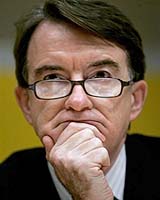
European Union trade chief Peter Mandelson on Friday urged China to address the urgent issue of climate change and reduction of green house gases while pursuing stellar economic growth. At a seminar in Beijing on trade and climate change, Mandelson called on China, which still relies heavily on coal power, to start looking at the environmental costs of its rapid development and to remedy the problems.
"Nowhere in the world do emissions shoot up the way they do in China where a new coal plant is put into service every week," he told academics, officials and business leaders.
He quoted former World Bank chief economist Nicholas Stern as saying that "the economic cost of climate change threaten to throw us back like the big depression did in the thirties of the last century."
"Is this sustainable when this growth is based on burning more and more fossil fuels?" he asked.
"So growth and trade might be part of the problem. Can they be made more sustainable? How can they become part of the solution?"
Mandelson warned that as China is set to become the world's biggest green house gas emitter, it must be actively involved in international discussion on trade and its impact on the environment.
"China must be at the center of any future discussions and trade and climate change."
He noted the European Union and China have already begun to cooperate on climate change and said Europe was ready to offer its expertise on clean coal, renewable energy, energy efficiency and carbon sequestration.
He also admitted that developed countries have a "special responsibility" as they are accountable for more than 80 percent of all greenhouse gases ever produced.
During his visit in China this week, Mandelson also agreed with Chinese Commerce Minister Bo Xilai to set up a task force on sustainable trade.
China is currently the second largest emitter of energy-related carbon dioxide emissions after the United States, but its share of world carbon emissions is expected to increase to 17.8 percent by 2025.
Sixteen of the world's 20 most polluted cities are also in China and 70 percent of Chinese cities do not meet World Health Organization air pollution standards.
Source: Agence France-Presse
