
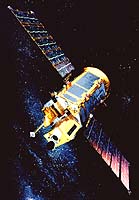
The Republic of Korea has delivered the Korean Multipurpose Satellite (Kompsat) to Vandenberg Air Force Base in California, where launch preparations are underway. Built by the Korean Aerospace Research Institute (KARI) with support from TRW Inc., Kompsat is scheduled for launch later this year.
Key launch preparations include an integrated system test to ensure the satellite's flight worthiness. Following this test, the satellite will be fueled, mated to a Taurus launch vehicle and transported to the launch site for final preparations.
"The upcoming launch is a major milestone in the Republic of Korea's space program," said Joanne Maguire, vice president and general manager, TRW Space & Laser Programs Division. "Kompsat has helped to enhance Korea's space development infrastructure, and following its launch, will make contributions to the country's scientific knowledge. We are very proud to be associated with this effort."
TRW assisted KARI in the assembly and test of the 1,034 pound flight model spacecraft at its KARI facilities in Taejon with components from both U.S. and Korean industrial companies.
The flight model spacecraft is the second in the Kompsat-1 program, which called for the development of two spacecraft based on TRW's lightweight satellite bus technology. The first spacecraft, a protoflight model, was built at TRW's Space Park facilities. KARI and Korean industry engineers participated in the program from its inception, honing the skills necessary to design, built, test, launch and operate a spacecraft.
The flight model spacecraft hosts scientific instruments that will map Korea, monitor ocean color and earth resources and perform space physics experiments. TRW built the electro-optical camera that will provide cartography data for developing digital elevation maps of the Korean peninsula for land use and planning purposes. TRW, along with KARI and Korean industry, also built the Low Resolution Camera that will provide color imaging of the ocean areas surrounding the Korean peninsula. A space physics monitoring experiment, developed by SatRec of Korea Advanced Institute of Science and Technology, completes the payload complement.
