
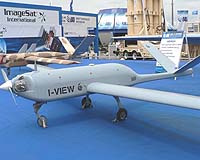
Israel has sold Russia 12 of its second-tier unmanned aerial vehicles, which the Russians badly want to produce themselves.
But the $53 million deal is reported to have a catch: Russia should not sell its advanced S-300PMU air-defense system to Iran, which wants the missiles to protect its nuclear facilities from Israeli air and ballistic missile strikes.
It is surprising in many ways that the sale went forward at all. Russia is the main arms supplier to Iran as well as its sole Arab ally, Syria, the most intransigent of the Arab states that oppose Israel.
And within the aerospace industry the Russians have made no secret that they wanted to get their hands on the Israeli drones, which are deemed to be among the best in the world and have been used by the Americans in Iraq, to reverse-engineer them so Moscow could produce its own sophisticated system.
Jane's Defense Weekly, published in London, quoted Vyacheslav Dzirkain, deputy head of Russia's Federal Service for Military-Technical Cooperation, as saying in Moscow in June: "We must take their (knowledge) and put it to practical use."
But the upheaval in Iran apparently has led the Israelis to believe that keeping the Russians sweet by allowing them to steal UAV technology is more important than other considerations.
Russia has ordered 50 UAVs, including the Bird-Eye 400, I-View Mk150 and the Searcher 2. But the Israelis say that the current sale involves only 10 550-pound I-View close-range tactical UAVs and long-endurance, multirole Searchers. Both are produced by the state-owned Israel Aerospace Industries.
Russia has been making UAVs for several decades, but it has never been able to match the quality of U.S. and Israeli craft.
The U.S. Predator MQ-1 UAV, armed with Hellfire missiles, has been highly effective against insurgent forces in Iraq, Afghanistan and Pakistan.
Israel pioneered the use of UAVs in combat. These figured prominently in the Israeli air force's stunning victory over Syrian air force fighters and surface-to-air missile batteries in Lebanon's Bekaa Valley in the initial phase of the Israeli invasion of 1982.
Eighty-six Syrian jets were shot down and a dozen missile batteries destroyed in that action. Later on, the Israelis deployed UAVs in surveillance operations against Palestinian militants in the occupied territories. In recent years, missile-firing UAVs have been used to assassinate militant leaders.
Russia's weakness in the UAV field was exposed during the 2008 war with Georgia. Moscow's forces had to use Israeli-built Hermes 450 craft built by Elbit Industries in the tactical role in that brief conflict.
According to Jane's, "Moscow has since launched a range of programs to address this shortfall. In 2008, Russian Air Force commander Colonel-General Alexander Zelin said that by 2011 Russia would be capable to deploying advanced UAVs with a flight duration of 12 hours and a range of 400 kilometers."
Zelin acknowledged, "We are desperately behind other countries, although in the 1980s we were at the front line."
Share This Article With Planet Earth
