
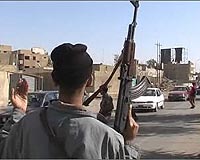
Iraqi police on Thursday said they had captured the head of an insurgent group close to executed dictator Saddam Hussein's still fugitive deputy Izzat Ibrahim al-Duri.
The Nakshabandiya group claimed responsibility in January for shooting down two American helicopters near the northern oil city of Kirkuk and killing four US troops.
"We have arrested Imad Shaker Mahmud, as a result of intelligence on his location, and we found a computer with the names of members of his network," interim Kirkuk police chief Torhan Yusuf Abdelrahman told AFP.
The US military said in February that an investigation had shown the downed helicopters had been hit by enemy fire, after initially rejecting claims of responsibility from Nakshabandiya at the time of the January 26 attack.
Abdelrahman said they had uncovered details of Nakshabandiya operations in the raid as well as dozens of the group's members.
"We have arrested 85 members, some of whom we are still interrogating but the majority are now in the hands of justice," he added.
Earlier this week Iraqi Prime Minister Nuri al-Maliki confirmed the arrest of Abu Omar Baghdadi, a shadowy figure believed to be the head of Al-Qaeda in Iraq, hailing it as a victory against the group.
However a streak of bombings has meanwhile convulsed the capital, killing scores of people and brutally underscoring the continuing ability of insurgent groups to carry out attacks despite improvements in security.
Al-Qaeda behind recent Iraq violence: Gates
Al-Qaeda is behind a recent spate of bombings in Iraq designed to sow sectarian strife and take advantage of a drop in US troops, Defense Secretary Robert Gates said on Thursday.
General Ray Odierno, commander of US forces in Iraq, and other senior officers believe "that most of the violence that we are seeing in Iraq today, these suicide bombings, are in fact the work of Al-Qaeda in Iraq," Gates told a Senate hearing.
He spoke after a wave of near-simultaneous bombings on Wednesday killed more than 50 people in mostly Shiite districts of Baghdad.
"They are clearly trying to take advantage of our draw down and particularly our drawing back away from the cities, to try and provoke a renewed round of sectarian violence," he said.
Gates was referring to a US agreement with the Iraqi government that requires US forces to withdraw from Iraq's cities by the end of June and from the whole country by the end of 2011.
"This is an orchestrated effort on the part of Al-Qaeda to try and provoke the very kind of sectarian violence that nearly tore the country apart in 2006," he said.
Political decisions by Iraq's Shiite prime minister, Nuri al-Maliki, were not to blame for the violence, Gates said, though he added Maliki had "problems" with those with ties to Saddam Hussein's toppled regime.
The Iraqi army on Thursday pinned the blame for the violence in Baghdad on Saddam loyalists.
Security has improved dramatically since US and Iraqi forces began allying with local tribes and former insurgents in late 2006 to combat Al-Qaeda and other militias, but attacks are still common.
April has been the bloodiest month since the start of the year, with more than 300 people killed and more than 700 wounded, according to an AFP tally based on reports from security officials.
Share This Article With Planet Earth
