
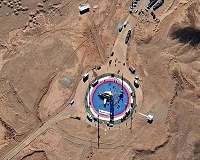
Previously, the US condemned Iran's launch of a military satellite into low orbit, claiming that the act violated a UN Security Council resolution.
Iran's Foreign Ministry has stated that its recent launch of the "Noor" ("Light" in Farsi) military satellite doesn't violate any international resolutions. The ministry's spokesman stressed that in this light, the US attempts to appeal to UN Security Council Resolution 2231 to condemn the Iranian actions are not adequate.
Earlier, US Secretary of State Mike Pompeo said that Iran should "be held accountable for what it's done", claiming that the launch violated Resolution 2231. Russia disagreed with Washington's view, arguing that the US itself has "flagrantly breached" the norms of international law and violated the resolution and is now simply trying to divert attention.
One of the provisions of the Security Council Resolution 2231 calls on Iran to abstain from testing and launching any type of ballistic missiles, including those used in space programmes, but does not ultimately prohibit them or threaten with any sanctions for ignoring it.
More Launches to Come
In a separate statement, the spokesperson for the Islamic Revolutionary Guard Corps (IRGC) Air Force announced that Tehran is planning to launch another military satellite into orbit. The spokesman said it will be called "Noor-2", but made no mention of its capabilities or functions. Little is also known about the purpose of "Noor-1", apart from the fact that it will be used by the Iranian military.
Tehran announced on 23 April that the satellite had successfully reached orbit, although the American military was at first hesitant to confirm Tehran's success. The launch was preceded by a series of failures to send civilian satellites into low Earth orbit.
Despite being civilian in nature, these launches were also condemned by the US, which suspects Iran of developing ballistic missiles for military purposes via its space programme. Washington also claims that the Islamic Republic is developing nuclear weapons in order for them to later be installed on the ballistic missiles. Tehran itself has ruled out the creation of both nuclear arms and long-range missiles.
Iran's Launch of Military Satellite Complies With UNSC Resolution on Nuke Programme – Moscow
The Islamic Revolutionary Guard Corps launched Iran's first military satellite, Noor, into orbit by using a Qassed rocket. The US said it was keeping track of the satellite, also describing its launch as a "hostile" act by Tehran.
The launch of a military satellite by Tehran on Wednesday did not contradict the UN Security Council resolution on Iran's nuclear programme, Russian Foreign Ministry spokeswoman Maria Zakharova said at a briefing.
"This would not be the first time that a nation that has flagrantly breached the norms of international law and violated UNSC resolution 2231 is trying to deflect international condemnation by baselessly accusing Iran of incompliance with the requirements of the Security Council", Zakharova said.
The spokeswoman underlined that the resolution, as well as the JCPOA regulating the Iranian nuclear programme, in no way restricts Iran's rights and abilities to explore space for peaceful purposes.
Zakharova added that Iran is not developing ballistic missiles capable of carrying nuclear weapons.
"There are no, there have never been, and hopefully there will never be nuclear weapons in Iran. Iran, adhering to the resolution, does not develop, test or use ballistic missiles capable of carrying nuclear weapons, unlike the United States, which surprises the world every single day with news about plans to develop their nuclear missile capabilities", she said.
On Wednesday, the Iranian military said that its first military satellite, Noor – which means "light" in Farsi, had been successfully placed in orbit 425 kilometres (624 miles) above the Earth's surface using a Qassed carrier. US Secretary of State Mike Pompeo doubted that the launch complied with UN resolutions.
