
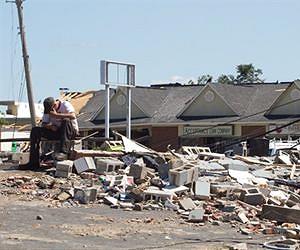
James Robinson lost his house in the tornado that devastated Tuscaloosa, Alabama six days ago and on Tuesday he leaves hospital with his legs and face in bandages, not knowing where he's going to live.
Like thousands of others injured last week in the deadliest tornado outbreak in the United States since 1925, which claimed the lives of 350 people across the US south, this 60-year-old man is slowly recovering but now faces the harsh reality of homelessness.
"I'm leaving the hospital and I don't know what I'm going to do. I don't have anywhere to go," he said.
His wife, who suffered more serious injuries, was moved to a medical center in Birmingham, an hour away. Robinson wants her with him and hopes she'll return soon.
"I need to think what to do. It's a very tough time and I want my wife to be here. We've made decisions for 42 years together," he said.
More than 800 people were admitted to the emergency room at Tuscaloosa's DCH Regional Medical Center in the hours after a massive, two-kilometer-wide (1.2-mile-wide) tornado roared through the city April 27.
Entire neighborhoods were wiped off the map. Modest houses were blown away. And with hundreds of people still unaccounted for, search and rescue teams continued to scour mountains of rubble for victims.
The storms and tornadoes — the worst natural disaster since Hurricane Katrina in 2005 — have come during a wet spring that has also caused floods in the central United States.
Further north, the US Army Corps of Engineers late Monday detonated explosives to blow breaches into levees below the confluence of the Ohio and Mississippi Rivers to relieve pressure from historically high waters.
In Alabama, the state most severely punished by last week's storms, the human toll is more than 250 dead and 2,200 injured, most of them in Tuscaloosa, where 5,000 homes have been destroyed and some 13,000 people affected.
Other states had their share of victims. In Mississippi, 35 people were killed, in Tennessee 34, in Georgia 15, in Arkansas eight, in Virginia five.
In her room at the Tuscaloosa regional hospital, April Watson is recovering from a blow to the head by an air conditioner that fell on top of her and knocked her out.
Her husband, Robert Reed, is by her side with a bag of ice on his head. He was hit in back of the head by an airborne automobile tire.
His wife has a long, deep cut in her foot that has become infected, and will require surgery.
"When my husband found me unresponsive with the air condition unit on top of my head, he thought I was down. My daughter came calling me, 'Mom, Mom.' I didn't hear her… but then my eyes came up."
"I'm just blessed to be here. God saved my life, he saved my family's life," she said.
She said they had thought of leaving the house before the tornado hit, but then the power went out, plunging them in darkness and then the giant twister struck and blew it all away.
Besides the injured, hundreds of people who didn't know where else to go took refuge in the hospital that night, which with its own generators was the only place in town with lights.
"People came (as if) from a jungle, walking in the darkness over the ruins," said Brad Fischer, a spokesman for the DCH Regional Medical Center. "There were people everywhere, in the conference rooms, corridors, cafeteria."
In the hours and days that followed school buses and public transport were used to ferry the homeless to shelters and homes of relatives, said Fischer, adding that 100 people remain hospitalized and six have died, including three children.
Religious and humanitarian aid organizations are sheltering thousands who lost their homes.
The American Red Cross has opened 16 shelters in Alabama, which have taken in 900 people, the organization said.
"This operation will take time. The devastation is immense," Daphne Hart, a Red Cross spokeswoman said.
Share This Article With Planet Earth
