
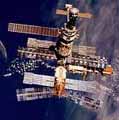
Washington DC – August 27, 1997 – NASA Administrator Daniel Goldin is facing strong sentiment with the U.S. civil space agency to end or sharply curtail the U.S. astronaut visits to the Mir space station in the face of the latest crisis aboard the aging station. But this time, NASA officials in Moscow are telling the administrator that the Russians themselves are starting to waiver as to the ability of the Mir to deliver sufficient power and experiment space to complete the series of extended U.S. visits, which now has two more astronauts planned.
Goldin has doggedly stuck by his Russian partners throughout the summer of
1997 as a host of troubles and malfunctions have struck the space station.
The latest crisis arose Monday when both the primary and secondary oxygen
regeneration systems on Mir failed for a time. While the "failure" of the
secondary was in fact the failure of only one of dozens of canisters flown
aboard Mir, sources in Washington say the Russians refused at first to
provide complete details on the incident to NASA officials. And then the
Russian Space Agency moved to downplay the whole event, leaving NASA
spokespersons in Houston caught in a public relations flap over whether or
not there was a crisis in the first place.
Political critics of the shuttle-Mir project are out of town while the
U.S. Congress is in recess, but the barbs are expected to fly again when
the politicos return next week. Expect Goldin to get grilled once again
over this latest "event" with the Russian space facility. Some within NASA
are urging Goldin to cut his losses and cut the remaining astronaut
exchanges, calling the program a success in the process. How quickly Mir
stabilizes, and how much power is actually restored following last week's
successful EVA repair will likely tell the tale.
