
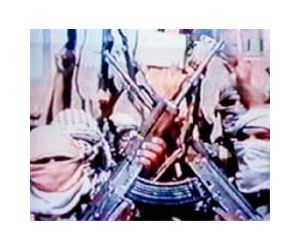
The French fear Islamist militants plan to attack European cities, suggesting that Paris may be gearing up to launch pre-emptive military action against al-Qaida in the Islamic Maghreb.
Jihadists kidnapped five French citizens and two African employees of France's state-owned nuclear company Areva in Niger on Sept. 16, six weeks after beheading a 78-year-old French hostage in Mali.
But if the French were limiting their response to the Niger abductions to flying surveillance missions over the vast Sahara Desert in search of the jihadists and their captives, Mauritanian troops probed into the region and clashed with AQIM in running gun battles over the weekend.
Mauritanian officials said 12 militants and eight soldiers were killed in attacks on AQIM bases Friday and Sunday, with six AQIM members captured. AQIM claimed Wednesday it killed 19 soldiers during the military offensive for the loss of one of its fighters.
The French Foreign Ministry says that while it has had no proof from the militants, authorities believe the captives are alive and being held in a remote region of Mali, Niger's western neighbor.
Adding to French anger and frustration, three Frenchmen were captured by pirates off Nigeria's Atlantic coast hundreds of miles to the south of Niger Wednesday.
The heavily armed pirates were fleeing a fight with the Nigeria navy during an attack on an oil platform when they boarded a French-flagged ship operating in the offshore oil field and kidnapped the three men.
There was no connection with the events in Niger or Mali but the attacks on its strategic energy interests in North and West Africa could well prove to be a catalyst for stepped-up counter-terrorism operations by the French military and intelligence services.
Niger and the countries of the Maghreb region, once part of France's colonial empire in Africa, produces 40 percent of its uranium. That gives the region strategic importance for France, which draws 80 percent of its energy from nuclear plants.
Areva has operated in Niger for 40 years. Its uranium mines at Arlit and Akouta produced more than 3,000 metric tons in 2008, or about 7 percent of global output. When a new mine at Imouraren starts up in 2013-14, it's expected to produce another 5,000 metric tons a year.
The Areva kidnappings in northern Niger marked an eastward expansion of Algeria-based AQIM's operational zone in the Sahara and the semi-arid Sahel region, suggesting further clashes with France.
This may be because of increased military pressure by Algeria, the region's military heavyweight, and more recently Mauritania as well. The Algerians are spearheading a new region-wide offensive against the militants launched last spring.
The nerve center for this is the Algerian air base at Tamanrasset deep in the southern Sahara not far from the border with Niger. It is from there that the French surveillance aircraft hunting the jihadists and their captives are probably operating.
It is likely that for now the French will reinforce their military missions in their former colonies and step up support for the Algerian-led military operations.
AQIM, particularly its southern wing in the Sahara, is reported to have been building underground bunkers and laying minefields to counter the emerging offensive by regional powers.
Western intelligence services have long feared the Algerian militants, by far the most active in the region, would unleash attacks on France, as they did in the 1980s and '90s, and possibly elsewhere in Europe.
That hasn't happened but France's national police commander, Frederic Pechenard, declared Wednesday: "We're facing a peak threat that can't be doubted. There is a specific threat against French interests."
French President Nicolas Sarkozy declared war on AQIM after it killed the elderly French hostage, Michel Germaneau, July 24 to avenge a botched bid to rescue him by French and Mauritanian troops in which six militants were killed.
Following the Areva kidnappings, AQIM cautioned Paris" "We warn you against taking any unwise actions."
The U.S. global security consultancy Stratfor noted that Sarkozy's popularity "is at an all-time low and he has been using distractions — such as a ban on Muslim face veils and deporting illegal Roma residents — to defray criticism.
"A show of force in the Maghreb could become part of that strategy."
Share This Article With Planet Earth
