
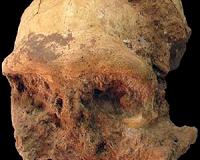
A group of scientists in eastern China's Anhui province recently unearthed a fossilized skull belonging to Homo erectus. The well preserved skull was found at the fossil-rich Hualongdong archaeological site.
Researchers have not yet had the chance to precisely date the skull, but believe it is between 150,000 and 412,000 years old.
Since 2006, when researchers first began digging at Hualongdong, the remains of a variety of ancient animal species have been discovered, alongside stone tools, as well as teeth, bones and skull fragments belonging to early hominids.
The newest find is one of the fullest and best preserved skull fossils yet found at the site.
It is quite uncommon to find such a great variety of fossils at a single site," Liu Wu, a scientist with the Institute of Vertebrate Paleontology and Paleoanthropology at the Chinese Academy of Sciences, said in a press release. "It bears great scientific value for the research of human evolution in China and East Asia."
Hualongdong is quickly becoming one of the most important hominid archaelogical sites in the country, on par with Zhoukoudian, in Beijing, where researchers first uncovered Peking Man, one of the earliest Homo erectus fossils found in China.
Stone Age elephant butchering site found in Greece
Megalopolis, Greece (UPI) Nov 25, 2015 –
Some 500,000 years ago, when you needed at good cut of elephant meat, you came to this lakeside spot — a butchering site near modern day Megalopolis, Greece.
The site, a place where hunters gathered to carve their kills, was discovered at an archaeological hot spot known as Marathousa 1. In addition to a complete Elephas antiquus skeleton, researchers have found a range of flora and fauna remains.
Marathousa 1 is one of the oldest archaeological sites in Greece. Today it exists in an open-cast coal mine, but the site was positioned on the shore of a shallow lake.
Alongside the animal remains, researchers have found a variety of stone tools, including hunting and butchers instruments. Blade marks in elephant bones attest to the meat carving that happened here, between 300 and 600 thousand years ago.
"That makes Megalopolis the only site in the Balkans where we have evidence of an elephant being butchered in the early Paleolithic," researcher Katerina Harvati, a professor at the Senckenberg Center for Human Evolution and Palaeoenvironment at the University of Tübingen, said in a press release.
Researchers believe Marathousa 1 lies along the route of early hominid — and later human — migrations out of Africa and into Europe and Asia. The region and its moderate climate likely also served as a respite for animals during periods of glaciation.
"Despite this crucial geographic position, paleoanthropological and paleolithic research has been under-represented in the region due to a traditional focus on later prehistory and Classical times," Havarti said. "As a result, very little information exists on the Lower Paleolithic of Greece. Marathousa 1 is of paramount importance for the understanding of human dispersal patterns into Europe, as well as the adaptations and behavior of early humans in the region,"
Havarti and his colleagues shared their most recent findings in a new paper, published recently in the Antiquity Journal.
