
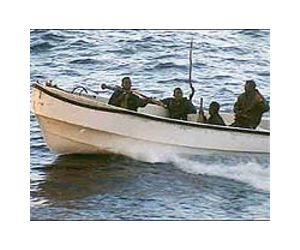
The EU naval force protecting shipping off Somalia said Wednesday it had disrupted 18 pirate gangs during March as bandits return to the seas following the monsoon season.
EU Navfor said that this month it saw double the number of groups encountered in September, October and November put together as pirates resume activity in the Indian Ocean and the Gulf of Aden.
In March there were nine hijackings, 17 unsuccessful attacks, 18 "pirate action groups" disrupted, and 22 skiffs destroyed.
Some 131 pirates were apprehended, with 75 being sent to Kenya and 11 being handed over to the Seychelles for prosecution.
"It is important that the ships that are going through the Gulf of Aden and the Somali Basin are aware of the dangers, that they report to us, that we know where they are. Then we can apply as much military protection as we can," said Commander Andreas Kutsch.
"We are on a constant chase for the 25 percent of ships who are not reporting to us."
There are eight vessels and 157 hostages now in the hands of Somali pirates, Kutsch said.
"There is a human dimension to this as well. It is not all about ransom money, ships, oil and cargo," the German naval chief said.
"These people more or less get traumatised during the period when they're under hijack, with the constant fear of being killed."
The main task of EU Navfor's Operation Atalanta is to escort merchant vessels carrying World Food Programme (WFP) humanitarian aid and to protect vulnerable ships in the Gulf of Aden and Indian Ocean.
No WFP ships have been hijacked since the operation began in December 2008. Around 60 transits have been escorted through the waters prowled by pirates, bringing more than 350,000 tonnes of food aid to Somalia.
The force's operational hub is at the Northwood Headquarters complex, in the suburbs northwest of London.
Pirates free two West African sailors: Nigerian navy
Lagos (AFP) March 31, 2010 –
Pirates freed Wednesday two West African sailors seized at the weekend off the coast of Cameroon, a Nigerian navy officer said, adding it was not clear if the demanded ransom was paid.
The pirates attacked the Ghanaian captain of the MV Seagull and his Cameroonian engineer on Saturday off the restive Bakassi peninsula, Nigerian Navy spokesman commodore David Nabaida told AFP.
When the pirates found nothing of value on board, they captured the seamen and demanded a ransom.
"They were released this morning in Bakassi," Nabaida said.
Nabaida said the pirates had demanded a ransom of 1.5 million Nigerian naira (10,000 dollars, 7,400 euros). On Tuesday he said the demanded amount was in dollars.
The spokesman said Wednesday he was not sure any ransom had been paid.
"We are not too sure of the identity of the kidnappers but if they made demands in naira, it could suggest they were Nigerians," he said.
The two sailors had been held in Abana, a major town in the oil-rich Bakassi peninsula which was part of Nigeria before the territory was ceded to Cameroon a year and a half ago.
Seven Chinese fishermen were this month freed by an armed gang in Cameroon's southwest Bakassi region after six days in captivity.
The International Maritime Bureau has identified Africa as a piracy hotspot following an increase in attacks from 2008, with Somali and Nigerian waters the most dangerous for seafarers.
Share This Article With Planet Earth
