
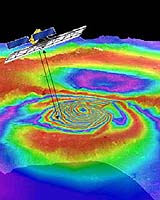
British scientists studying a large fault zone in northern Chile say they've gained insight into how fluid pressure can cause earthquakes.
The University of Liverpool researchers discovered fluids, such as water, become sealed within the Earth's fault planes for a long period of time and make it easier for the Earth's plates to move alongside each other, causing an earthquake.
Professor Dan Faulkner said the difficulty with predicting earthquakes is that little is known about how fault planes work.
"In theory, high stresses are needed to cause slip along a fault plane, but if something like pressurized water or gas gets inside the fault, then it should act as a kind of cushion, making movement between plates easier and an earthquake more likely."
Until now, most geologists believed fluid pressures increased the likelihood that rocks would crack and the fluids could escape, reducing the "cushion" effect.
"Our recent study, however, found much smaller cracks surrounding the fault plane change the stresses acting on the rock, reducing the likelihood of significant cracks forming and allowing the fluid to escape," said Faulkner.
The study appears in the current issue of Nature Magazine.
