
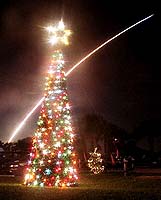
Space shuttle Discovery's much-delayed mission to repair the Hubble space telescope finally got under way Sunday, with NASA scientists breaking into applause and cheering what they called a near-perfect blast-off.
The relief felt at the Kennedy Space Center here was visible on the faces of NASA officials, who have had to delay the mission nine times due to weather or technical problems.
After Discovery made what officials at the National Aeronautics and Space Administration called an almost perfect liftoff at 7:50 p.m. Sunday (0050 GMT Monday), the shuttle moved into an orbit 600 kilometers (360 miles) above the Earth.
"We'll see you back here before the next millennium," launch director David King told the crew moments before lift-off.
Discovery's mission has faced obstacles all around, with a string of technical problems and uncooperative weather keeping the shuttle grounded for months. NASA wanted to finish the mission before year's end to avoid any possible run-ins with year 2000 computer problems and to prevent having to re-train the astronauts.
And the US space agency could use the morale boost, after losing the Mars Polar Lander earlier in December and the Mars Climate Orbiter in September.
The mission, the 96th for the US space shuttle program and the 27th for Discovery, aims to repair the Hubble telescope, which has been disabled since mid-November.
Three spacewalks will be needed to fix the Hubble telescope, which is in orbit 600 kilometers (373 miles) from Earth.
The telescope is equipped with six gyroscopes, but four of them are out of order. A minimum of three functional gyroscopes is needed for the Hubble to maintain its position in space and gather information effectively.
Discovery is to hurtle through space for two days before reaching the Hubble. It will then grasp the telescope with a robotic arm and draw it into its hold.
Once the Hubble has been transferred to Discovery's hold, its gyroscopes are to be replaced, along with its onboard computer and one of its radio transmitters.
Touchdown back on Earth was set for after Christmas, making this space mission the first in more than two decades to have astronauts in space during the holiday. The last was the Skylab mission in 1973.
But to make the holiday in space a bit easier, two astronauts packed along some culinary treats. France's Jean-Francois Clervoy brought along blocks of duck fois gras. Menus on this mission also include cassoulet gimontois with grilled coarse pork sausage, salted pork with Puy green lentils, duck bordelaise with ceps, and chili with Gascon-style duck breast.
Switzerland's Claude Nicollier also brought along Swiss chocolates — shaped like tiny space shuttles — for his crewmates, in addition to recordings of Mozart's "Requiem," music from the Andes, the opening to Wagner's "Lohengrin," "Nocturnes" by Chopin, tunes by folksinger Joan Baez, and "Oxygen" by Jean-Michel Jarre.
