
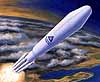
Officials have
scrubbed the launch of a Boeing Delta III expendable launch
vehicle carrying the Orion 3 spacecraft for Hughes Space and Communications.
The launch team made three attempts during tonight's window, which
spanned from 9:13 to 10:22 p.m. EDT. Vehicle issues, which were resolved, caused the first two delays. Officials halted the third attempt after the launch team ran out of time to test a repaired Air Force tracking radar. A new launch date will be set at a later time pending range availability.
Delta 3 To Try Again
Cape Canaveral – April 5, 1999 – Delta III Launch of Orion 3 Satellite Delayed Range safety concerns related to wind direction and speed have delayed the launch of a Boeing Delta III expendable launch vehicle carrying the Orion 3 spacecraft for Hughes Space and Communications and Loral Space & Communications. The rocket was scheduled for launch at 9:14 p.m. EDT today.
The rationale behind the scrub was as follows: if the U.S. Air Force
range safety officers needed to destroy the launch vehicle during the early ascent phase of flight, the resultant toxic plume might impact populated areas.
Boeing is proceeding with plans for a launch tomorrow, Tues., April 6 at 9:13 p.m. EDT. The launch window extends to 10:22 p.m. EDT. The team will evaluate weather conditions and will issue updated launch information tomorrow.
Boeing and Loral will provide a live video feed beginning at 9 p.m. EDT. Ku-band transmission will be carried on Telstar 5, Transponder 19. The downlink is 12035 vertical. Video streaming can be accessed via Boeing.
Cape Canaveral – April 1, 1999 – The newest addition to the Boeing Delta rocket family will lift off here in less than a week, carrying the Hughes-built Orion 3 satellite for Loral Space & Communications.
A Boeing Delta 3 rocket, scheduled for launch at 9:14 p.m. EDT, April 5, from Space Launch Complex 17, will place the Orion 3 satellite into orbit. The launch window extends through 10:23 p.m. EDT. Weighing 9,480 pounds (4,300 kg), Orion 3 is the largest payload ever to be launched to geosynchronous transfer orbit by a Delta launch vehicle.
The Orion 3 satellite will expand the C-band and Ku-band coverage area of Loral's satellite service fleet to include the entire Asia-Pacific region including Korea, China, Japan, Australia, India, Southeast Asia, Oceania and Hawaii.
The launch marks the return to flight of the Delta 3, after its Aug. 28, 1998, inaugural flight carrying the Galaxy X satellite was cut short approximately one minute and 20 seconds into flight. During the investigation that followed, the failure was determined to be caused by a roll mode not accounted for in the control system.
"Although we recognize the significance of this launch as the return to flight for Delta 3, our No. 1 priority is supporting our customers and ensuring the success of their mission," said Jay Witzling, vice president, Delta II and Titan programs. "We're looking forward to a successful launch that will advance our customers' goals and objectives while showing the world that the Delta 3 program is back on track," he said.
Delta 3, featuring a larger fairing to house bigger payloads and a new cryogenically propelled upper stage with a Pratt & Whitney-built single-engine, uses existing components and infrastructure similar to that used with the Delta II launch vehicle, but can boost twice the payload into orbit.
Boeing has 17 firm contracts for Delta 3 launches; 12 for satellites built by Hughes Space and Communications Company, which includes the Orion 3 satellite, and five launches for Space Systems/Loral. The company considers Delta 3 an evolutionary step toward the Delta IV family of launch vehicles. Boeing plans the first launch of Delta IV in 2001.
Delta 3 engineering, manufacturing and program management is led by Boeing Expendable Launch Systems, based in Huntington Beach, Calif., with final assembly in Pueblo, Colo. The Delta launch team at Cape Canaveral Air Station, Fla., handles launch coordination and operations. Boeing manufactures the Delta 3 main engine, the RS-27A, in Canoga Park, Calif.
Major Delta 3 suppliers include: Alliant Techsystems, Inc., Magna, Utah, strap-on solid rocket motors; Pratt & Whitney, West Palm Beach, Fla., RL10B-2 cryogenic upper-stage engine; Mitsubishi Heavy Industries of Nagoya, Japan, 13-foot (4 m) fuel tanks; and AlliedSignal, Teterboro, N.J., Redundant Inertial Flight Control Assembly avionics system.
