
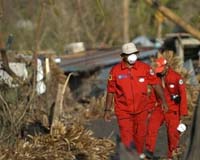
The first foreign aid flights of food and medicines arrived Tuesday in the eastern Philippines, where officials said devastating mudslides had left at least 1,266 people dead or missing. At first light two C-130 transport aircraft from Indonesia touched down in Legaspi city, where disaster relief operations are being coordinated, carrying more than 12 tonnes of food and medicine.
A small team of Spanish firemen set up a field hospital nearby for the injured survivors.
The devastating torrents of mud and volcanic ash triggered by typhoon rains swallowed more than 700 villages near Mayon volcano on Thursday during the height of super typhoon Durian, one of the strongest cyclones ever to hit the Philippines.
Survivors desperately picked through the thick deposits trying to find loved ones, but rescuers said the search was hopeless.
President Gloria Arroyo flew to the region Tuesday to commiserate with the survivors and ordered area officials to speed up relief work.
"Government at all levels must cooperate and consolidate resources to bear upon this tragedy," she said in a statement that thanked foreign donors.
"The search for victims must continue as we tend to the sick and hungry in the evacuation centers, but we must now also push on the search for permanent solutions bearing upon the root cause of these grave calamities," she added.
Daniel Fernandez, of the Spanish search and rescue team BUSF, said "the search for life is over". Typhoon Durian, now downgraded to a tropical storm, continued its deadly passage overnight, lashing the coast of southern Vietnam, where officials said at least 23 people had died and more were missing.
In the Philippines, civil defence officials confirmed 526 dead, mostly around Mayon volcano in the Bicol region, southeast of Manila, and another 740 missing.
The civil defense office said the typhoon and the mudslides had also destroyed or damaged 250,000 houses and affected 1.54 million people, nearly 83,000 of whom had sought refuge at evacuation centers.
It put the cost of the damage to buildings, infrastructure and agriculture at 1.2 billion pesos (24.2 million dollars).
Official sources said Arroyo ordered utility officials to restore electricity throughout Bicol in two weeks. The region of 4.6 million people is still without power, with downed transmission pylons lying unattended near highways.
The typhoon also washed away bridges, hampering relief efforts in far-flung hamlets.
Teams from the health department were making their way to villages to help deal with the dead.
Many unclaimed bodies have been buried in shallow graves but many more are still lying unrecovered.
For those who lived through the disaster, there was heartache as they dug for the bodies of family members.
In Maipon, Aljabar Mammah wept as he clawed through the grey soil where his home once stood, vainly hoping to find the bodies of his wife and baby son.
"Nobody had time to react. My wife and son were snatched from my arms and were gone in an instant," he told AFP.
The Chinese government would donate 200,000 dollars to the Philippines to help with the aid efforts, foreign ministry spokesman Qin Gang told reporters in Beijing Tuesday. The Chinese Red Cross has also given 50,000 dollars.
earlier related report
Tropical storm Durian kills at least 55 in Vietnam
Hanoi (AFP) Dec 5 – At least 55 people died and 26 were missing Tuesday when severe tropical storm Durian hit Vietnam, destroying houses and sinking boats after wreaking deadly havoc in the Philippines, officials said.
The storm was downgraded from the powerful typhoon that left more than 1,200 people dead or missing when it triggered a mudslide in the Philippines.
Twenty-eight people died and sixteen were missing in Ba Ria-Vung Tau, east of Ho Chi Minh City, in a province which has tourist resorts and offshore oil rigs, said Nguyen Ngoc Loc of the flood and storm control committee.
In the Mekong Delta province of Ben Tre, 17 people were reported dead and there were fears of more casualties in the poor and geographically flat region, where many people live in wooden huts or on house boats.
Durian made landfall in southern Vietnam overnight, with lashing rains and wind speeds of nearly 120 kilometres (75 miles) per hour, smashing thousands of houses, uprooting trees and bringing down power lines.
It sank more than 800 boats moored on a remote South China Sea island before brushing Ho Chi Minh City, the country's largest city, and heading southwest across the Mekong Delta.
The Vietnamese island of Phu Quy, 250 kilometres (150 miles) east of Ho Chi Minh City, the former Saigon, suffered heavy damage as the storm lifted the roofs off more than 1,000 houses, but there were no reported casualties.
Two people were reported dead in Tien Giang province, two were missing and 20 were injured, said flood and storm control committee official Nguyen Duc Thinh.
"More than 6,600 houses were damaged and 26 schools unroofed," he said, adding that authorities had evacuated nearly 13,000 people.
Two more people were killed by falling trees in Binh Thuan province, three people died in Phu Yen province, and one was killed in Vinh Long, with three more missing, officials said.
Meteorologists had expected the storm to hit further north, where troops had helped Monday in evacuating tens of thousands of people, but preventive action in the provinces further south appears to have averted a worse disaster.
"We had evacuated 3,500 people," said Tran Thi Luan, head of the Ben Tre provincial flood and storm control committee.
"If the evacuation had not happened, the toll would have become much higher. The storm was really strong."
Wind speeds slowed to 100 km/h in the afternoon, when Luan said "the weather seems to be better, but we do not dare yet tell people that the storm is over, because this is a really complicated storm".
Ho Chi Minh City escaped the worst as the eye of the storm passed to the south. Vietnam television, however, said two people were killed in the country's business capital.
More than 8,000 people were evacuated from high-risk areas, but there were still fears for some people missing.
Officials in the seaside resort of Nha Trang said they had no immediate reports of casualties.
Communist Vietnam, which in May lost more than 240 fishermen and scores of boats to typhoon Chanchu, days ago barred fishing vessels from leaving harbour and warned those at sea to seek shelter to avoid the typhoon.
Central Vietnam was in October hit by typhoon Xangsane, which killed at least 70 people and brought widespread flooding and destruction.
Source: Agence France-Presse
